
Business statistics is a core analytical discipline that enables organisations to make informed decisions under conditions of uncertainty. By applying statistical methods to business data, companies can identify patterns, quantify risk, evaluate performance, and improve strategic planning. In an era defined by volatile markets, complex supply chains, and rapidly expanding data availability, statistical reasoning has become central to effective business management, as highlighted across modern data governance and analytics frameworks developed by the OECD.
Rather than relying on intuition or anecdotal evidence, businesses increasingly use statistical analysis to support decisions related to pricing, investment, operations, and customer engagement. This shift toward evidence-based decision-making reflects a broader transformation in how organisations manage risk and allocate resources in data-intensive environments, a trend also observed in global business analytics practices documented by the World Bank.
This blog examines the evolution of business statistics, explains its core concepts, explores how different industries apply statistical tools, and outlines why statistical thinking remains a foundational capability for businesses navigating complexity and uncertainty.
A Brief History of Business Statistics
The roots of business statistics stretch back centuries, intertwined with the evolution of commerce itself. In the 17th century, merchants in Europe began using rudimentary data collection to track trade volumes, profits, and losses. This was the era of “political arithmetic,” pioneered by figures like William Petty, who used quantitative methods to analyze economic trends. Fast forward to the 19th century, and the Industrial Revolution sparked a surge in statistical applications as factories needed to monitor production, costs, and workforce efficiency.
The 20th century brought a revolution with the advent of modern statistical tools. Figures like Ronald Fisher introduced concepts like hypothesis testing and regression analysis, which became foundational to business analytics. By the mid-1900s, companies like Ford and General Electric were using statistics to optimize assembly lines and forecast demand. Today, with the rise of big data, artificial intelligence, and cloud computing, business statistics has evolved into a sophisticated science that drives everything from marketing campaigns to supply chain management.

What Is Business Statistics?
At its core, business statistics is the science of collecting, analyzing, interpreting, and presenting data to solve business problems. It blends mathematical techniques with real-world applications, helping organizations make informed decisions rather than relying on gut instinct. Whether it’s predicting sales trends, assessing customer satisfaction, or measuring operational risks, statistics provide the clarity businesses need to thrive.
There are two main branches: descriptive statistics, which summarizes past data (think averages, percentages, and charts), and inferential statistics, which uses samples to make predictions or draw conclusions about larger populations (like forecasting or testing hypotheses). Together, they form a toolkit that businesses tailor to their specific needs.
Chapter 1 – An Intro to Business Statistics
Types of Business Statistics by Industry
While the core principles of business statistics are universal, their application differs across industries based on decision cycles, risk exposure, and data intensity. In practice, businesses adapt statistical tools to answer sector-specific questions rather than applying generic models.
1. Retail and E-Commerce
Retail and e-commerce businesses use statistics primarily to manage demand uncertainty and customer behaviour.
Demand forecasting: Historical sales data is analysed using time-series and regression models to anticipate seasonal and regional demand fluctuations, a practice widely documented in retail analytics research by McKinsey & Company.
Pricing and promotions: Statistical testing helps evaluate price elasticity and promotional effectiveness without relying on intuition.
Personalisation: Recommendation systems are built on machine-learning models, but their performance is validated using statistical techniques to avoid bias and overfitting.
2. Finance and Banking
In financial services, business statistics underpins risk management, compliance, and forecasting.
Credit risk assessment: Probability distributions and regression models are used to estimate default risk and loss exposure.
Fraud detection: Statistical anomaly detection identifies unusual transaction patterns before losses escalate.
Market and portfolio analysis: Time-series analysis and optimisation models help manage market volatility and asset allocation, aligning with risk frameworks outlined by the Bank for International Settlements.
3. Healthcare and Pharmaceuticals
Statistics play a central role in evidence-based decision-making in healthcare and life sciences.
Clinical trials: Hypothesis testing and sampling techniques determine the safety and efficacy of new drugs.
Healthcare operations: Predictive models help hospitals anticipate patient demand and allocate resources efficiently.
AI validation: Even as AI tools expand, statistical methods remain critical for validating diagnostic models, a point emphasised in data and analytics guidance by the World Health Organization.
4. Manufacturing and Supply Chain
Manufacturing firms use statistics to control quality, efficiency, and operational risk.
Quality control: Statistical Process Control (SPC) monitors defect rates and production variability.
Process improvement: Methodologies such as Six Sigma rely on statistical analysis to reduce variation and improve consistency, as outlined by the American Society for Quality.
Supply chain planning: Forecasting models help anticipate demand shifts and reduce inventory imbalances.
5. Marketing and Advertising
In marketing, statistics supports measurement, experimentation, and optimisation.
Campaign evaluation: A/B testing uses statistical hypothesis testing to compare creative variants and messaging strategies.
Customer segmentation: Clustering techniques group customers based on behaviour and preferences.
Brand perception: Statistical models combined with text analysis track sentiment across digital platforms, aligning with marketing analytics standards discussed by the American Marketing Association.
6. Technology and IT Services
Technology firms apply statistics across product development, security, and performance optimization.
System monitoring: Statistical anomaly detection helps identify outages, performance issues, and security breaches.
Product analytics: User interaction data is analysed statistically to improve usability and engagement.
AI governance: Statistical reasoning is essential for model testing, bias detection, and reliability assessment, as reflected in AI and data governance guidance from the OECD.
7. Real Estate and Construction
In real estate and construction, statistics supports valuation, risk assessment, and planning.
Property valuation: Regression-based pricing models estimate property values using location, demand, and amenity data.
Project risk management: Probability models help forecast cost overruns and schedule delays.
Urban planning: Spatial statistics inform infrastructure and land-use decisions, consistent with urban development approaches discussed by the World Bank.
Importance of Business Statistics
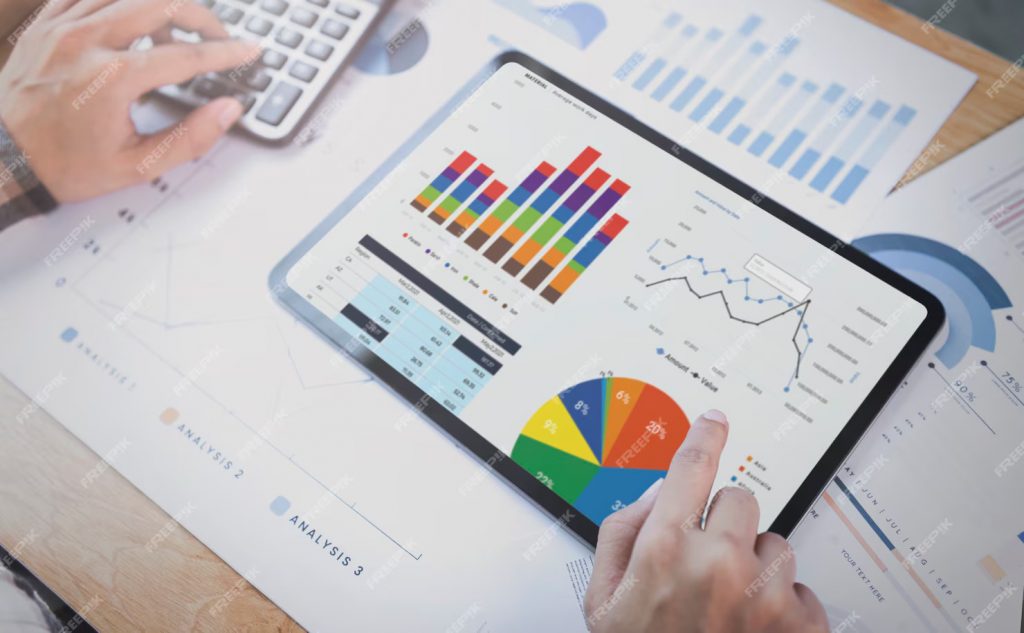
Business statistics plays a vital role in various aspects of business operations, contributing to better decision-making and improved efficiency. Below are the key reasons why business statistics is essential:
1. Data-Driven Decision-Making
Statistics help businesses move away from guesswork and make informed decisions based on actual data. Organizations analyze past performance and market trends to develop strategies that align with business goals.
2. Market Analysis and Consumer Insights
Companies use statistical tools to analyze customer behavior, purchasing patterns, and market trends. This enables them to tailor products, optimize marketing campaigns, and enhance customer satisfaction.
3. Risk Management and Forecasting
Businesses use probability analysis and predictive modeling to assess financial risks, economic downturns, and operational challenges. This proactive approach minimizes uncertainties and helps in contingency planning.
4. Operational Efficiency and Cost Optimization
Statistical analysis improves supply chain efficiency, reduces waste, and optimizes production processes. By analyzing operational data, businesses can identify bottlenecks and enhance overall productivity.
5. Quality Control and Performance Measurement
Industries like manufacturing rely on statistical process control to maintain product quality. Businesses also use key performance indicators (KPIs) to evaluate employee performance and improve business strategies.
6. Financial Planning and Investment Strategies
Business statistics play a crucial role in financial modeling, budgeting, and investment analysis. By assessing financial data, organizations can make strategic investment decisions and optimize resource allocation.
7. Competitive Advantage
Companies that utilize business statistics effectively can stay ahead of their competitors by making data-backed decisions, improving customer experiences, and identifying new market opportunities.
How Businesses Leverage Business Statistics
Businesses across industries rely on statistics to enhance their operations. In retail and e-commerce, for example, companies use statistical methods for customer segmentation, demand forecasting, and targeted marketing.
Industry | Key Applications |
|---|---|
Retail & E-Commerce | Customer segmentation, demand forecasting, price optimization, personalized recommendations. |
Finance & Banking | Credit risk analysis, fraud detection, portfolio management, insurance risk assessment. |
Healthcare | Clinical trials, disease prediction, hospital resource optimization, AI-driven diagnostics. |
Manufacturing & Supply Chain | Quality control, process optimization, predictive maintenance, supply chain analytics. |
Marketing & Advertising | Consumer behavior analysis, A/B testing, ad performance tracking, customer retention. |
Financial institutions employ business statistics for credit risk assessment, fraud detection, and portfolio management. The healthcare sector benefits from statistical analysis in clinical trials, predictive modeling for disease outbreaks, and AI-driven diagnosis based on patient history. Manufacturing firms use statistical quality control and process optimization to minimize defects and improve production efficiency. In marketing and advertising, consumer sentiment analysis and A/B testing are applied to measure campaign effectiveness and optimize brand strategies.
How Top Companies Put Business Statistics to Work

Let’s ground this in reality with some compelling examples:
Walmart’s Inventory Magic: Walmart uses predictive analytics to manage inventory across thousands of stores. By analyzing past sales, weather patterns, and local events, they ensure shelves are stocked just right—saving billions annually.
Coca-Cola’s Marketing Precision: Coke analyzes social media sentiment and sales data to tailor campaigns. In 2018, their “Share a Coke” campaign used statistical insights to pick the most popular names by region, boosting engagement.
Tesla’s Production Edge: Tesla employs statistical quality control to monitor battery production. By analyzing defect rates in real time, they maintain their reputation for cutting-edge tech.
Starbucks’ Location Strategy: Before opening a new store, Starbucks crunches demographic data, traffic patterns, and competitor locations using statistical models to maximize foot traffic.
These giants don’t guess—they calculate, and that’s why they dominate their markets.
Challenges and the Future of Business Statistics
While powerful, business statistics isn’t without hurdles. Poor data quality can lead to flawed conclusions, and misinterpreting results can backfire—think of a retailer overstocking based on a faulty forecast. Plus, the rise of big data means businesses need skilled analysts or AI tools to handle the volume.
Looking ahead, the future is bright. Machine learning is supercharging statistical models, enabling real-time insights at scale. The United Nations Statistics Division (UNSD) is even pushing for global standards in business stats to harmonize data practices. As technology evolves, so will the precision and reach of this field.
End Note
Business statistics is not merely a technical function—it is a foundational discipline that shapes how organisations interpret data, manage uncertainty, and make decisions. From its early role in tracking trade and production to its current integration with advanced analytics and artificial intelligence, statistical reasoning has consistently underpinned effective business planning.
As data volumes grow and analytical tools become more sophisticated, the importance of sound statistical thinking is increasing rather than diminishing. Whether applied to forecasting demand, managing risk, evaluating performance, or validating AI-driven models, business statistics provides the structure and discipline required to turn data into reliable insight.
In an environment where decisions are increasingly data-driven, the ability to apply statistical methods responsibly and interpret results accurately remains a critical capability for organisations across industries.
FAQs
1. What is business statistics in simple terms?
Business statistics is the use of data and statistical methods to analyse business performance, understand trends, measure risk, and support decision-making across functions such as finance, marketing, operations, and strategy.
2. Why is business statistics important for decision-making?
Business statistics helps organisations make decisions based on evidence rather than intuition. By analysing data, businesses can reduce uncertainty, compare alternatives, and choose strategies with a higher likelihood of success.
3. What are the main applications of business statistics?
Business statistics is applied in areas such as sales forecasting, market research, quality control, financial analysis, risk management, pricing, inventory planning, and performance measurement.
4. What are the key types of business statistics?
The main types of business statistics include:
Descriptive statistics (summarising past data)
Inferential statistics (drawing conclusions from samples)
Predictive analytics (forecasting future outcomes)
Prescriptive analytics (optimising decisions using models)
5. How is business statistics used in different industries?
Industries use business statistics differently—for example, retail uses it for demand forecasting, finance for risk and credit analysis, manufacturing for quality control, healthcare for clinical and operational decisions, and technology firms for product and performance analytics.
6. What is the difference between business statistics and data analytics?
Business statistics focuses on statistical reasoning, probability, and inference, while data analytics includes broader tools such as machine learning and data engineering. In practice, analytics relies on statistical foundations to ensure accuracy and reliability.
7. How does business statistics help manage risk?
Statistical models help businesses estimate probabilities, assess potential losses, and evaluate uncertainty. This supports better risk management in areas such as finance, supply chains, investments, and operations.
8. What skills are required to apply business statistics effectively?
Applying business statistics requires statistical thinking, data interpretation skills, basic mathematical understanding, and domain knowledge, along with the ability to communicate insights clearly to decision-makers.
9. How will business statistics evolve in the future?
As businesses increasingly use AI and big data, business statistics will play a critical role in model validation, bias detection, and decision accountability, ensuring that advanced analytics remains reliable and interpretable.

Other articles


We work with individuals, startups, and NGOs dedicated to forging a sustainable future. Tell us about your mission.