
- All articles
Reviving Weaving Traditions with Banana & Bamboo Textiles - The story of MaLeeMa
By Ketul
Updated 08 Sep, 2024
10 min read
Contents
Main Menu
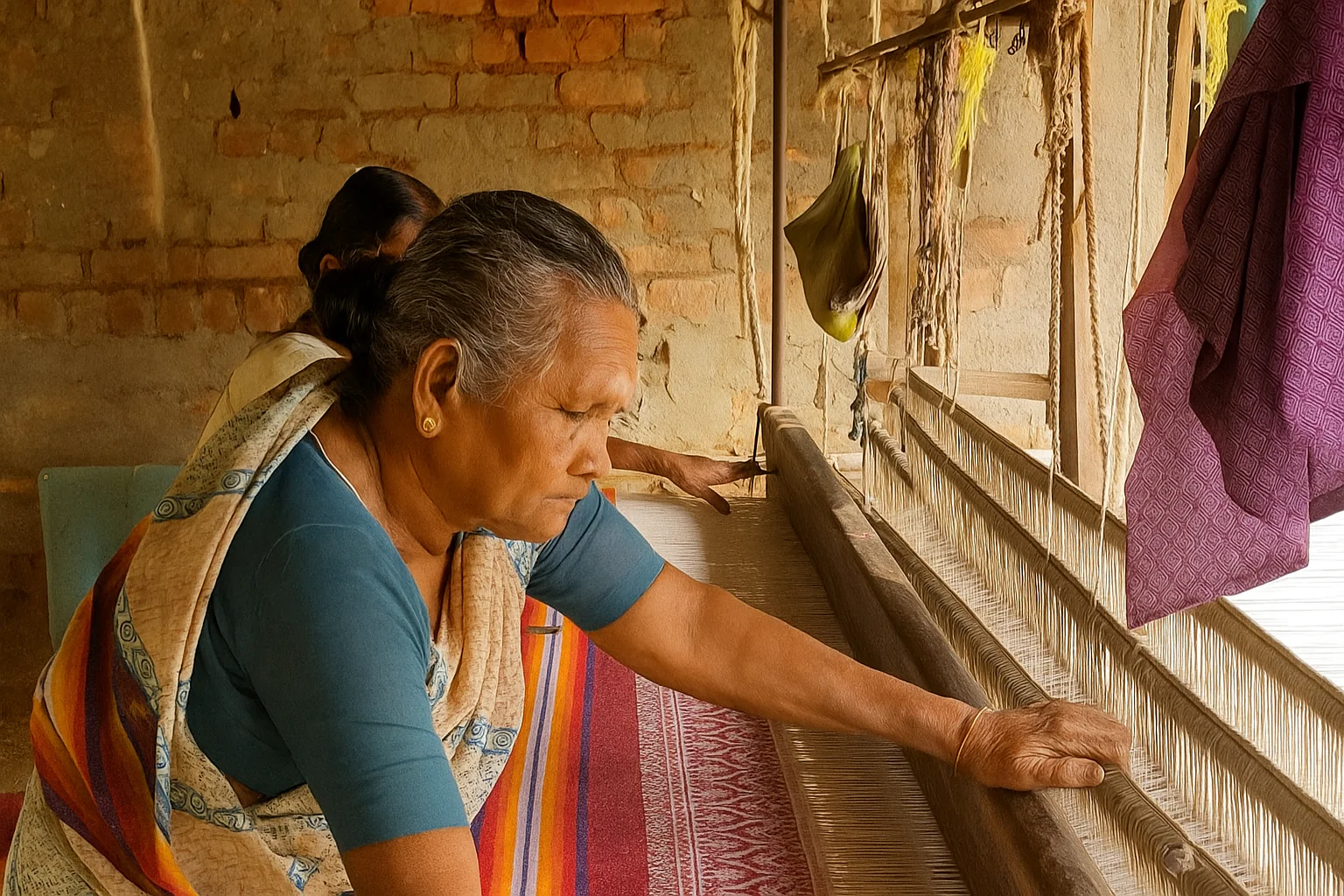
India is home to one of the world’s richest textile heritages, with over 3.5 million handloom workers (as per the Ministry of Textiles) and traditions that date back thousands of years. Yet, this same heritage is at risk. Research from the Centre for New Economics Studies shows that the average age of Indian weavers is rising dramatically because the younger generation sees no economic future in handloom work. As powerlooms and synthetic fibres dominate the market, the country’s ancient weaving clusters are shrinking, and many weavers survive on as low as ₹100–₹150 a day.
It is within this fragile landscape that Srinithyaa, founder of MaLeeMa, began her journey — a journey shaped by fashion, craft, agriculture, and a deep emotional connection to India’s textile legacy. MaLeeMa today works with weavers across Tamil Nadu and Madhya Pradesh, reviving banana-stem and bamboo-based textiles while ensuring fair wages, dignity and continuity for artisans.
This is her story.
A Career Worn Like Many Hats
Before MaLeeMa existed, Srinithyaa’s professional life was a collage of fashion roles. She studied fashion and apparel design, followed by fashion styling, and even ventured into fashion law. Her internships cut across merchandising, leather design, styling and production. “I worked as a merchandiser, designer, stylist… a lot of things,” she says with a laugh, reflecting on years that gave her a 360-degree understanding of the fashion value chain.
But the more she learned, the more she felt something missing. After COVID-19, she felt a growing desire to build something of her own — something rooted in Indian fabrics, craft, and sustainability. That desire took her back to the villages that hold India’s textile soul.
Travelling to India’s Weaving Heartlands
In 2021–22, equipped with nothing but curiosity, Srinithyaa began travelling across Tamil Nadu and Andhra Pradesh, meeting weavers, sitting inside small handloom homes, and observing processes that had remained unchanged for generations.
What she found was heartbreaking but illuminating.
Across multiple weaving clusters, the weavers she met were 50, 60, even 70 years old — a stark reflection of how the craft was ageing without successors. The economics were even harsher. “Some weavers get only ₹5 per metre for plain fabric,” she recalls. “Even if they weave 20 metres a day, that’s just ₹100.”
Even more painful was the fact that master weavers — people who spend their entire lives creating masterpieces like Kanjivaram or Patan Patola sarees — often cannot afford to buy the sarees they weave. Studies by the Indian Institute of Handloom Technology corroborate that artisan wages rarely match the value of their craft.
“There is so much middlemen interference,” she explains. “The work is beautiful. The pricing is not.”
These realities seeded the purpose that would become MaLeeMa.
Building MaLeeMa: A Commitment to Fair Wages and Fair Work
Srinithyaa knew she couldn’t fix the entire industry — but she could change the system around her. At MaLeeMa, she began with one non-negotiable value: fair labour wages, even if it increased her own costs.
She collaborated with entire weaving villages, training them on designs, setting up looms, and creating continuous work. One of her earliest collaborators was an elderly couple, both in their 60s or 70s, weaving together at home. “The wife would finish housework and come help her husband. It was so sweet,” she shares. “They were abandoned by their children, but they were happy working together.”
Stories like these shaped MaLeeMa’s decentralised production model — artisans weave from home, preserving both tradition and dignity.
A Period of Exploration and Freelancing
While exploring weaving clusters, Srinithyaa sustained herself through freelancing — designing collections, moodboards and production systems for friends’ brands. “I literally roamed,” she laughs. “Travelling, researching, and freelancing… that’s how 2021 and 2022 went.”
These freelance projects sharpened her production and styling skills — skills that would later help her build MaLeeMa’s product lines faster and more professionally.
The First Product: Bamboo T-Shirts
MaLeeMa’s first official product was a bamboo t-shirt — an idea born from the challenge of differentiating herself in a cotton-dominated Indian textile market. Bamboo fabric, though not yet mainstream in India, is globally recognised as a sustainable textile. The global bamboo textile market is projected to reach $2.4 billion by 2030, according to Grand View Research. Bamboo’s natural softness, antibacterial properties, and moisture-wicking ability make it a premium alternative.
“The first bamboo t-shirt I made 2–3 years ago… I still use it. It’s extremely soft. No holes. Same feel,” she says proudly.
But bamboo yarn in India largely goes into exports — a common pattern in textiles, where the best material leaves the country. She sourced the yarn, developed custom GSM fabrics (180 and 220), and launched her first batch.
Her first bulk order came from Canada — 650 pieces. “That was my biggest order,” she smiles. This was followed by repeat orders from London and other countries.
A Pop-Up That Changed Everything: Capgemini’s Prithvi Mela
Barely a month after launching her website on WordPress, Srinithyaa received an unexpected email: an invitation to Capgemini’s Prithvi Mela, a sustainability-focused pop-up.
“I had no idea what a pop-up stall even was,” she laughs. But she went — with t-shirts, shirts, and a banana-fibre scarf. The CEO of Capgemini India visited her stall. People touched bamboo fabric for the first time. Many were shocked: “Bamboo se kaise ho sakta hai?”
She didn’t care about sales; she cared about feedback. And the feedback was excellent.
Experimenting with Banana Fibre
Banana fibre, though used for baskets and ropes, is rarely used for clothing. But India produces over 28 million tonnes of banana stems annually (per the FAO), and most of it is discarded after harvest. Converting it into textiles, therefore, could create a significant circular economy opportunity.
MaLeeMa’s first banana-fibre product was a scarf — but the process was incredibly manual.
“We couldn’t convert it to yarn. So women joined cotton and banana fibre by hand — every single thread.” She describes how fibers were combed, boiled, dried and manually twisted into yarn, then woven into scarves. “It was a big manual process, but fun.”
Today, MaLeeMa produces banana yarn more systematically, converting about 20+ tonnes of banana stems into fiber in the last few months alone.
The B2B Expansion
Despite being built as a retail brand, MaLeeMa’s real momentum came from B2B buyers — Indian and international designers wanting sustainable yarns and fabrics.
Interestingly, the website doesn’t even mention fabric supply — yet enquiries pour in. “People buy for the quality, the story, and the sustainability… all three,” she says.
Her B2B clients customise GSM, colours, blends and patterns. Some experiment for markets like France and the U.S.
Working With Handloom Artisans: The Real Challenge
Running a decentralised handloom supply chain is beautiful — and chaotic.
If the quality isn’t right, Srinithyaa rejects entire batches. Drying time varies. Production halts during festivals. “Someone will say, ‘Ma’am, muje moonjha festival hai,’ and I have no choice,” she laughs. “For handcrafted products, there is no backup. You just work overnight and finish it.”
But this unpredictability is part of the handloom world — where art lives inside homes, where tradition flows through generations, and where human warmth shapes every product.
What’s Next for MaLeeMa?
When asked where she wants to take MaLeeMa, Srinithyaa says something that sounds both bold and poetic:
“Imagine replacing the entire textile industry with sustainable banana stem. Decentralised weaving units in villages. Farmers extracting fibre after harvest and selling it like cotton.”
Her dream mirrors the future of circular textiles — local fibres, local production, global markets.
Lessons for Eco-Entrepreneurs
Shruti’s journey has shaped a set of practical, grounded lessons — the kind that come not from theory but from walking through villages, negotiating with artisans, managing inconsistent supply chains, and convincing customers one by one. Her reflections offer a blueprint for anyone building a sustainability-led venture in India.
1. Quality Comes Before Sustainability
One of her biggest realizations is that people do not purchase products simply because they are eco-friendly. They buy them because they are beautiful, durable, functional, and comfortable. Sustainability is important, but it is the bonus, not the base.
“People don’t buy because it’s sustainable. They buy because the quality is good — sustainability is just the brownie point,” she says.
Her advice: Build a product that competes with mainstream alternatives on merit. Let sustainability become the reason they feel good about buying it — not the reason they buy it.
2. Fair Wages Are Non-Negotiable
From day one, Malima was built on the belief that artisans must earn enough to live with dignity. In a sector where weavers are often underpaid, her stance is firm: fair wages may raise costs, but compromising on them is not an option.
“Even if it costs me more, I pay my weavers fairly. That is the one thing I will never change,” she emphasizes.
It’s a reminder that sustainability is not only about materials — it is also about people.
3. Design Matters More Than You Think
Shruti learned that even the most sustainable material will fail if the design doesn’t excite customers. Sustainable fashion cannot look dull or “earthy” by default. Customers want aesthetics, comfort, and identity.
“People want beautiful things. If the design is not nice, they will not buy it — even if it’s 100% eco-friendly,” she explains.
Her take: sustainability must meet aspiration. The product must stand on its own legs.
4. Build Big Dreams, but Stay Rooted in Process
Shruti has ambitious dreams — decentralised weaving clusters, farmers extracting banana fibre after harvest, Indian fabrics competing globally. But she insists that dreamers must also become disciplined builders.
“Dream big, yes — but be very grounded in your process,” she says.
She believes eco-entrepreneurs often underestimate how much time, trial and error, and operational discipline sustainability businesses demand.
Closing Reflection
MaLeeMa is not just a textile brand. It is a bridge between India’s agricultural waste, its weaving heritage, and a new sustainable fashion future. Srinithyaa’s journey — from designer to explorer to entrepreneur — shows how powerful entrepreneurship becomes when rooted in empathy, craft and community.
Her story reminds us that the future of Indian textiles may not lie in large factories, but in small homes where elderly hands weave beauty into existence — and where founders like her make sure those hands are valued.
Related articles

Digital Marketing Solutions for Sustainable Businesses
Rittika Rana
November 27, 2025

From Concept to Reality: NeeRain’s Simple Solution to Water Scarcity
Himanshu Jangid
September 13, 2024
Ready to talk?
We work with individual initiatives, startups, and NGOs dedicated to forging a sustainable future with better design, marketing, technology & operations.