

- All articles
Future Industries in India 2026: Sustainability, Climate, and Circular Economy
By Ketul
Updated 13 April, 2026
10 min read

Contents
Main Menu
India’s economic landscape is undergoing a significant transformation. Rapid urbanisation, technological advancement, and shifting global priorities are redefining how industries grow and operate. But beyond digitalisation and scale, a more fundamental shift is taking place — one that is being driven by climate risk, resource constraints, and sustainability imperatives.
India is expected to become one of the fastest-growing major economies in the coming years. However, this growth is increasingly being shaped by environmental realities. Rising temperatures, water stress, waste generation, and supply chain vulnerabilities are forcing industries to rethink traditional models of production and consumption.
At the same time, global frameworks and national policies are accelerating this transition. Initiatives such as India’s climate commitments under the Paris Agreement and domestic missions promoting clean energy, waste management, and sustainable infrastructure are creating new opportunities across sectors.
As a result, the industries defining India’s future in 2026 are not just those that scale — but those that adapt, regenerate, and operate within environmental limits.
What Is Driving the Shift Toward Future Industries?

Several interconnected forces are shaping the emergence of new industries in India.
Climate Risk and Environmental Pressures
Climate change is no longer a distant concern. It is already affecting agriculture, water availability, infrastructure, and supply chains. According to the Intergovernmental Panel on Climate Change (IPCC), countries like India face increasing risks from extreme weather events, heatwaves, and changing rainfall patterns.
These risks are pushing industries to build resilience, adaptability, and long-term sustainability into their operations.
Regulatory and Policy Push
Governments are playing a critical role in shaping future industries. Policies related to renewable energy, waste management, electric mobility, and carbon markets are creating new economic ecosystems.
Programs such as India’s renewable energy targets and waste management frameworks are encouraging businesses to align with sustainability goals while opening up new market opportunities.
Resource Constraints
India’s rapid growth is placing pressure on natural resources. Water scarcity, land degradation, and raw material limitations are forcing industries to move toward efficient and circular resource use.
The shift from linear models (“take–use–dispose”) to circular systems is becoming a necessity rather than a choice.
Investor and Market Expectations
Sustainability is increasingly becoming a key factor in investment decisions. ESG (Environmental, Social, and Governance) frameworks are influencing how companies operate, report, and grow.
This is driving demand for industries that can deliver both economic value and environmental responsibility.
Key Future Industries in India
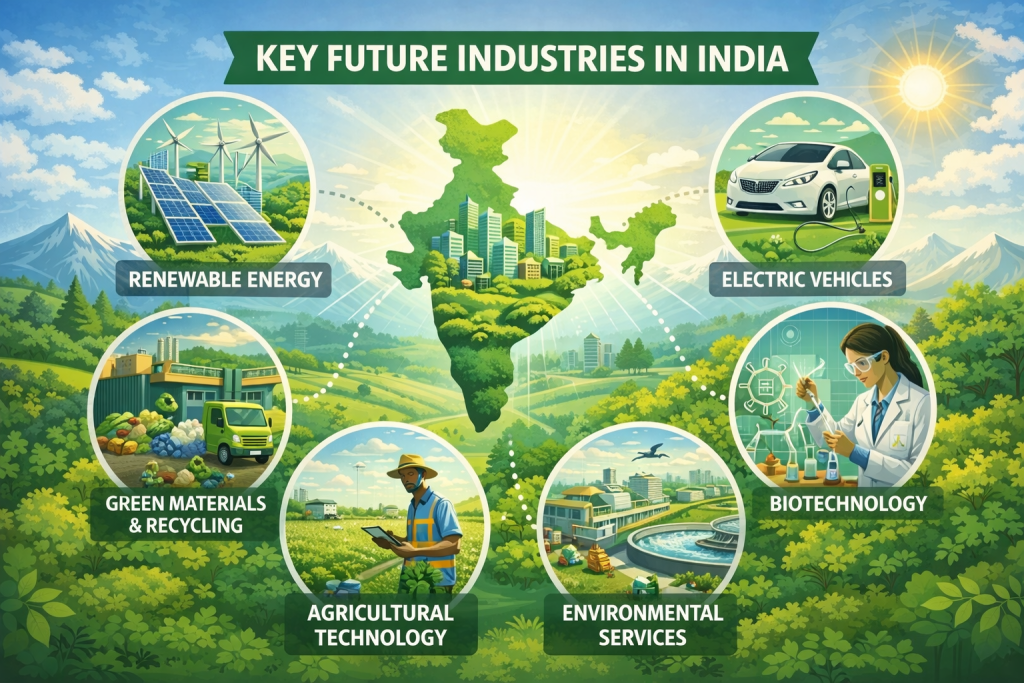
1. Climate and Carbon Markets
As climate commitments become more ambitious, carbon markets and climate finance are emerging as critical industries.
Carbon markets enable organisations to offset emissions through projects such as afforestation, renewable energy, and ecosystem restoration. India, with its vast landscapes and biodiversity, has significant potential to become a major player in nature-based carbon solutions.
Global frameworks discussed by organisations such as the World Bank’s carbon pricing initiatives highlight the growing importance of carbon markets in achieving climate targets.
This industry is expected to expand rapidly as companies seek to meet net-zero commitments and investors look for credible climate solutions.
2. Renewable Energy and Energy Storage
India’s renewable energy sector is one of the fastest-growing in the world. Solar and wind energy installations are increasing rapidly, supported by government policies and falling technology costs.
At the same time, energy storage systems, particularly battery technologies, are becoming critical for managing renewable energy supply and demand.
According to the International Energy Agency (IEA), India is expected to play a key role in the global clean energy transition, with renewable energy forming a significant share of its energy mix.
This industry is not only central to climate goals but also to energy security and economic resilience.
3. Circular Economy and Recycling
The circular economy is emerging as one of the most important industry shifts globally. Instead of disposing of materials after use, circular systems focus on reuse, recycling, and resource recovery.
In India, this includes industries focused on:
- recycling plastics and metals
- sustainable packaging
- construction material reuse
- waste-to-resource systems
The Ellen MacArthur Foundation has highlighted how circular economy models can significantly reduce environmental impact while creating economic value.
As waste generation increases and regulations strengthen, circular economy businesses are expected to grow rapidly.
4. Sustainable Agriculture and Food Systems
Agriculture remains a critical sector for India, but it is also highly vulnerable to climate change. Future agricultural systems will need to be more resilient, regenerative, and resource-efficient.
This includes:
- regenerative farming practices
- climate-resilient crops
- sustainable supply chains
- reduced food waste
Organisations such as the Food and Agriculture Organization (FAO) emphasise the importance of sustainable agriculture in ensuring food security while reducing environmental impact.
This sector will play a key role in balancing productivity, sustainability, and livelihoods.
5. Electric Mobility and Clean Transport
India’s transportation sector is undergoing a transition toward electric mobility. Electric vehicles (EVs), charging infrastructure, and battery ecosystems are becoming key areas of growth.
Government initiatives such as EV adoption policies and incentives are accelerating this shift.
Electric mobility not only reduces emissions but also improves urban air quality and reduces dependence on fossil fuels.
This industry is expected to expand significantly as cities push for cleaner and more efficient transportation systems.
6. Climate and Nature Intelligence
One of the most emerging and under-recognised industries is climate and nature intelligence.
As sustainability becomes more data-driven, there is growing demand for tools that can measure and interpret environmental impact. This includes:
- biodiversity monitoring
- climate risk analysis
- ecosystem health assessment
- nature-based project verification
Technologies such as remote sensing, AI, and bioacoustics are enabling organisations to translate environmental data into decision-ready insights.
This industry is particularly important for sectors such as carbon markets, conservation, infrastructure, and ESG reporting, where accurate environmental data is essential.
What This Means for Businesses

The rise of these industries signals a broader shift in how businesses operate.
Sustainability is no longer a separate function — it is becoming integrated into core business strategy, operations, and decision-making.
Organisations must now:
- understand environmental risks
- adapt to regulatory changes
- invest in sustainable systems
- align with ESG frameworks
Businesses that fail to adapt may face operational disruptions, regulatory challenges, and reputational risks, while those that embrace these changes can unlock new opportunities.
The Bigger Shift: From Growth to Sustainable Growth
The industries shaping India’s future are not just about scale — they are about how growth is achieved.
The shift is from:
- linear to circular systems
- extraction to regeneration
- short-term gains to long-term resilience
This transformation reflects a broader understanding that economic growth must operate within environmental limits and ecological balance.
Conclusion

As India moves toward 2026, the industries that will define its future are those that can balance economic growth with environmental responsibility.
Climate, sustainability, and circular economy principles are no longer optional — they are becoming foundational to how industries evolve.
Understanding these emerging sectors is not just about identifying opportunities. It is about recognising a deeper shift in how economies function.
The future of industry in India will not be built on scale alone —
it will be built on systems that sustain both business and the environment.
FAQs
1. What are the future industries in India by 2026?
Future industries in India are expected to be driven by sustainability and climate needs, including renewable energy, carbon markets, circular economy, electric mobility, and climate intelligence.
2. Which industries will grow the fastest in India by 2026?
Renewable energy, electric vehicles, recycling, and carbon markets are expected to grow the fastest due to strong policy support and rising demand.
3. Why are sustainability-driven industries growing in India?
These industries are growing due to climate change, stricter regulations, and increasing pressure to use resources more efficiently.
4. What is a circular economy in simple terms?
Circular economy focuses on reusing, recycling, and recovering materials instead of disposing of them after a single use.
5. How is climate change affecting industries in India?
Climate change is creating risks for supply chains, water availability, and agriculture, while also driving demand for sustainable solutions.
6. What are carbon markets and why are they important?
Carbon markets allow companies to offset emissions through environmental projects and are key to achieving net-zero goals.
7. How is renewable energy shaping India’s future economy?
Renewable energy is reducing dependence on fossil fuels while supporting economic growth and climate commitments.
8. What is climate and nature intelligence?
It refers to using data and technology to monitor climate risks, biodiversity, and ecosystem health for better decision-making.
9. What should businesses do to adapt to future industries?
Businesses should integrate sustainability, manage environmental risks, and align with ESG and regulatory expectations.
10. Why is ESG important for future industries in India?
ESG helps companies improve sustainability performance, attract investors, and stay compliant with evolving regulations.
Related articles

Digital Marketing Solutions for Sustainable Businesses
Rittika Rana
November 27, 2025

Why Composting?
missionsustainability
May 14, 2022
Ready to talk?
We work with individual initiatives, startups, and NGOs dedicated to forging a sustainable future with better design, marketing, technology & operations.