

- All articles
XEN Farms and the Indian Soil Reality
By Ketul
Updated 08 Sep, 2024
10 min read

Contents
Main Menu
A conversation with Diptesh on why sustainability must work in the first season
When we interviewed Diptesh, founder of XEN Farms, the conversation stayed away from dramatic claims and climate buzzwords. Instead, it repeatedly returned to one grounded idea:
Indian agriculture does not fail because farmers don’t care about sustainability.
It struggles because most sustainable transitions ask farmers to wait, and waiting is a risk they cannot afford.
This long-form article is built from that conversation—contextualised with data, policy realities, and on-ground insights—to understand why soil health in India must become commercially viable now, not later.
India’s soil problem: visible, measurable, and worsening
Soil degradation in India is not anecdotal—it is extensively documented.
According to the Indian Council of Agricultural Research (ICAR) and the Ministry of Agriculture, nearly 30–35% of India’s total land area is affected by various forms of land degradation, including erosion, salinity, nutrient depletion, and organic carbon loss.
(Source: ICAR–National Bureau of Soil Survey & Land Use Planning)
The FAO’s Status of the World’s Soil Resources report highlights that:
- Indian soils, on average, have significantly lower organic carbon than global benchmarks
- excessive nitrogen and phosphorus use has reduced nutrient-use efficiency
- soil compaction and reduced porosity are increasing irrigation stress
At the same time, fertiliser consumption has continued to rise. India used over 31 million tonnes of fertilisers in 2022–23, dominated by urea and DAP (Source: Department of Fertilisers, Government of India). Yet yield growth has slowed in several crops, indicating diminishing returns.
Farmers feel this directly:
- higher input costs
- weaker crop response
- greater vulnerability to pests and climate variability
The soil is still producing—but under strain.
Why “wait for soil recovery” doesn’t work for most farmers

Organic and natural farming approaches are increasingly promoted across India. The government itself has announced plans to support 1 crore farmers in transitioning to natural farming systems (Union Budget 2023–24).
But most agronomists acknowledge a hard truth:
the transition curve usually involves an initial yield dip, often lasting 2–5 years, depending on soil condition and practices.
For a small or marginal farmer—who makes up over 85% of India’s farming population (Agricultural Census)—this dip is not theoretical. It affects household income, loan repayments, and food security.
This is the core problem Diptesh points to:
sustainability framed as delayed reward creates resistance, even when farmers agree with the long-term logic.
Diptesh’s background: where systems thinking enters agriculture
Diptesh’s thinking is shaped by contrasts.
He grew up in a paddy-farming family in rural West Bengal, where agriculture was about seasonal survival. Later, he trained as a mechanical engineer at IIT Bombay (2011) and moved into system modelling and digital twins—disciplines that study how complex systems behave under stress.
His exposure to controlled-environment agriculture and a later project linked to ISRO’s PSLV mission, where a germinated seedling was sent into space, sharpened his understanding of one thing:
Plants perform best when systems are balanced, not when individual inputs are maximised.
That insight became foundational to XEN Farms.
What XEN Farms is building—and what it is not
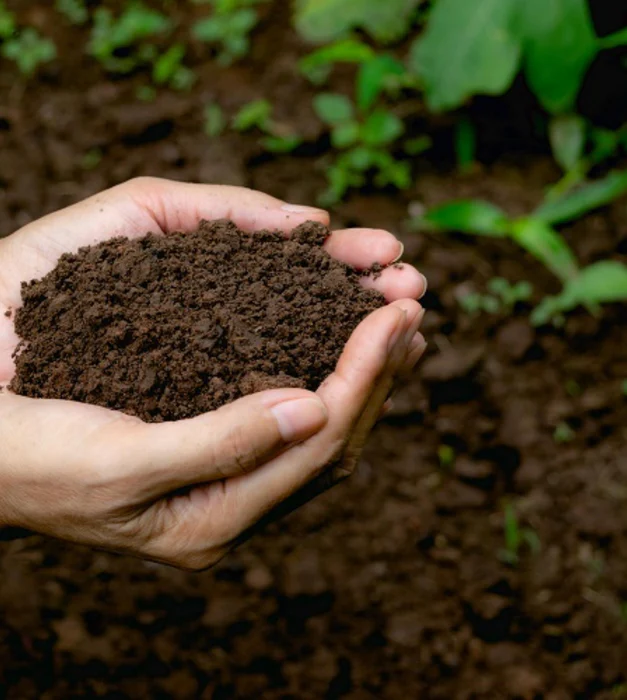
XEN Farms has developed a nanocarbon-based soil and plant nutrition input, offered in both liquid and solid forms.
Importantly, the company does not position this as a “miracle fertiliser” or a replacement for soil biology. The stated objective is to restore soil function by addressing stress factors that prevent soil from doing what it naturally does.
The approach focuses on:
- reducing chemical residue stress
- improving soil structure and porosity
- supporting microbial revival
- improving nutrient availability and uptake
- strengthening photosynthesis and plant health
The formulation remains the same across crops. Dosage and frequency vary based on:
- soil condition
- crop lifecycle
- climatic context
This design choice reflects a systems-first philosophy rather than crop-specific optimisation.
Why faster soil recovery changes adoption dynamics
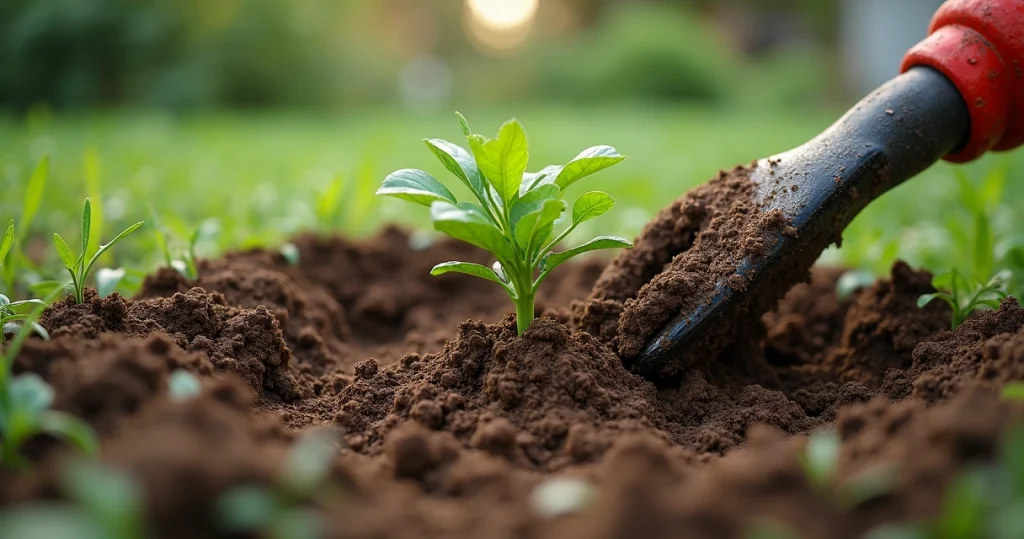
Research consistently shows that nutrient-use efficiency in Indian agriculture is low—often estimated at 30–40% for nitrogen, with the rest lost through leaching, volatilisation, or runoff (Source: FAO, ICAR).
When soils are compacted or biologically inactive, adding more fertiliser increases cost without proportionate yield gains.
XEN Farms positions itself as a bridge:
- enabling faster soil recovery (often within months rather than years)
- allowing farmers to see visible improvements in the first season
- stabilising yields during transition rather than reducing them
Farmers are not pushed to label their produce as organic. This matters because in Indian wholesale markets, grade and visual quality often influence price more than certification—especially in horticulture.
Field learnings across states and crops
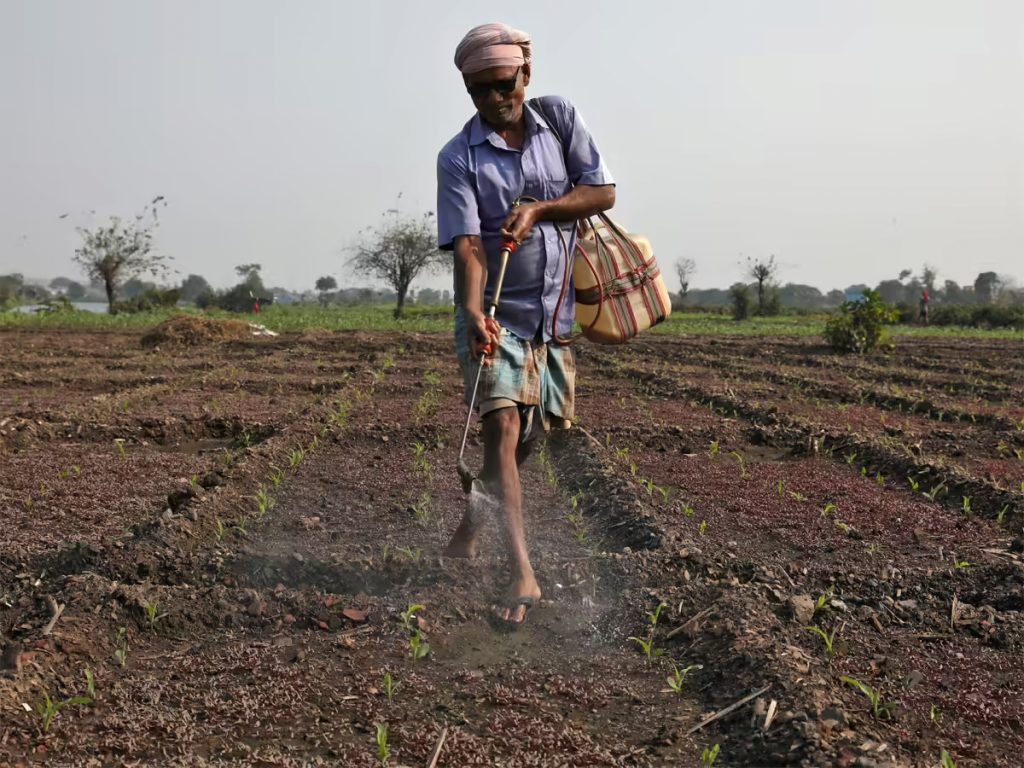
Over the last three years, XEN Farms has conducted demonstrations across 14–15 states, covering around 80 crops, and currently works with approximately 5,000 farmers.
One early large intervention was in Maharashtra’s pomegranate belt—an export-oriented crop sensitive to soil stress and nematode infestation. Farmers in pilot clusters reported:
- improved plant vigour
- better fruit setting
- higher market grades
Diptesh avoids uniform claims. Indian agriculture spans diverse soil types—from alluvial plains to black cotton soils—and climatic extremes. What matters, he says, is consistency of direction rather than identical outcomes.
Adoption in Indian agriculture is social, not transactional
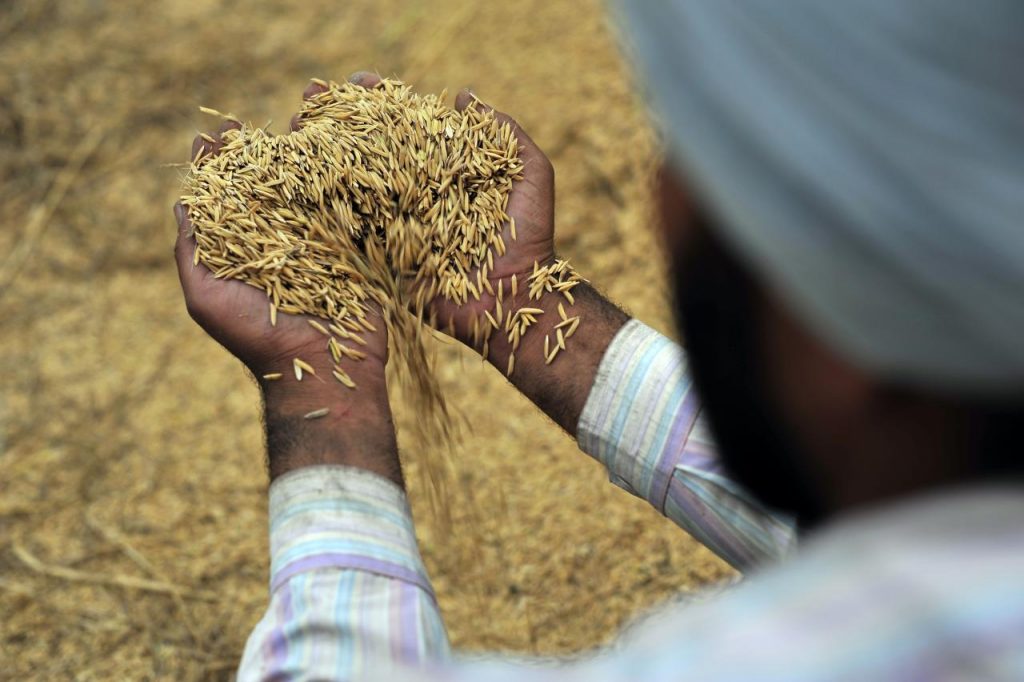
Multiple studies on agritech adoption in India highlight that farmer decisions are shaped less by advertising and more by peer validation and institutional trust (Source: IFPRI, NABARD working papers).
Farmers trust:
- local champions
- FPO leaders
- cooperatives
- NGOs and government-linked institutions
XEN Farms has designed its go-to-market around this reality. It works through Farmer Producer Organisations (FPOs) and collectives using a train-the-trainer model, where local agripreneurs act as guides and validators.
This slows early expansion—but significantly improves trust and long-term adoption.
The economics farmers actually evaluate
When farmers ask whether the solution is cost-effective, the answer is conditional. It depends on crop value, soil condition, and existing input costs.
Diptesh frames it as incremental economics:
- if a marginal increase in input cost results in a disproportionately higher return through yield or quality, adoption makes sense
- horticultural crops often show this equation more clearly than low-value cereals
No new equipment is required. Solid inputs are applied like conventional fertilisers, while liquids integrate with existing irrigation systems.
Incorrect usage—especially over-application—can reduce effectiveness. Precision, not intensity, is critical.
Building XEN Farms without chasing capital
XEN Farms has not raised venture capital. Instead, it has grown through:
- grants and incubations (including Wilgro, IRMA, TISS)
- institutional partnerships
- customer revenue
Diptesh is clear-eyed about this choice. Agriculture is slow. Crop cycles take 4–6 months. Missing a season can delay validation by half a year.
In such a sector, resilience and cash discipline matter more than rapid scaling narratives.
What comes next: digital, but farmer-aligned
XEN Farms is developing a digital platform focused primarily on FPO-level monitoring, not direct farmer apps.
The platform aims to:
- track crop progress using satellite data
- identify stress patterns
- deliver advisories via familiar channels like WhatsApp
The design principle is simple: do not ask farmers to change behaviour just to use technology.
The platform is intended to remain free for farmers, supported by other stakeholders in the agricultural value chain.
What this conversation reveals about sustainability in India
XEN Farms’ story is not about one product. It reflects a broader lesson:
Sustainability in Indian agriculture must align with:
- immediate economics
- social trust networks
- policy realities
- biological timelines
India does not lack ideas for soil health. It lacks solutions that respect farmers’ risk, time, and cash flow.
By focusing on faster soil recovery, partnership-led adoption, and commercial viability from the first season, XEN Farms is attempting to work within the reality of Indian farming—not above it.
And that may be the most sustainable approach of all.
Related articles

Mindful Consumption: A Way To Minimalistic Lifestyle
Ishita Paul
June 11, 2022

How can businesses be more environmentally friendly?
Nimisha Daga
January 30, 2024
Ready to talk?
We work with individual initiatives, startups, and NGOs dedicated to forging a sustainable future with better design, marketing, technology & operations.