
Corporate Social Responsibility (CSR) has emerged as a powerful tool for businesses in India to contribute to social and environmental causes. CSR in India has gradually evolved from a voluntary corporate practice into a regulated mechanism for channeling private capital toward public good. It has transformed from a voluntary act of goodwill to a mandatory requirement for large companies, thanks to the CSR mandate introduced under Section 135 of the Companies Act, 2013. In recent years, CSR spending in India has seen significant growth, with corporations becoming more accountable for their social and environmental impact.
This report provides an overview of the CSR in India, focusing on the CSR expenditure over the last two years, regional distributions, sector-wise allocations, and a closer look at the top companies leading the way in CSR activities.
It also highlights emerging trends and early signals shaping CSR direction through 2025–26.
What is CSR?

Corporate Social Responsibility (CSR) refers to a business model where companies integrate social and environmental concerns into their operations, beyond profit-making. In India, CSR is formally embedded within corporate governance frameworks rather than positioned solely as discretionary philanthropy. It is a way for companies to contribute positively to society, taking responsibility for their impact on various stakeholders, including employees, customers, communities, and the environment.
CSR in India initiatives often focus on areas like:
Sustainability: Reducing environmental impact, promoting renewable energy, and minimizing waste.
Philanthropy: Donations, charitable work, and volunteering to help communities and causes.
Ethical Labor Practices: Ensuring fair wages, safe working conditions, and respecting human rights.
Community Development: Investing in education, healthcare, infrastructure, and rural development.
Diversity and Inclusion: Fostering equal opportunities for all, regardless of gender, race, or background.
In India, CSR became mandatory for certain companies through the Companies Act of 2013, which requires businesses meeting specific criteria (like revenue and net worth) to spend at least 2% of their average net profits on CSR activities each year.
Overall, CSR contributes to structured social investment and national development objectives, moving beyond brand-building toward measurable social and environmental outcomes.
Who is Eligible for CSR?
In India, the Companies Act, 2013 outlines specific criteria for eligibility to undertake Corporate Social Responsibility (CSR) activities. Companies that meet any of the following conditions are required to allocate a minimum of 2% of their average net profit over the last three years to CSR:
Net worth of Rs 500 crore or more
Annual turnover of Rs 1,000 crore or more
Net profit of Rs 5 crore or more
These companies must ensure that their CSR activities are aligned with the guidelines and contribute to societal development in areas such as education, healthcare, rural development, and environmental sustainability. Companies falling under these criteria are also expected to form a CSR committee to monitor and oversee their CSR initiatives effectively.
They are also required to constitute a CSR Committee and disclose spending and outcomes in statutory filings.
CSR Spending Trends in India: Recent Data and Emerging Shifts (2022–2026)
According to the latest data, the total CSR in India spent by companies has consistently risen, with substantial contributions directed toward various sectors like education, healthcare, environment, and rural development.
1. CSR Spend in 2022-2023
Total CSR Spend: INR 29,986.92 crore (approximately)
India’s corporate social responsibility (CSR) spending increased to INR 29,986.92 crore in 2022-2023, up from INR 26,579.78 crore in 2021-2022. Key highlights include:
Sector-wise Spending: Education accounted for one-third of the total CSR spend, while technology incubators received the least.
CSR Projects: The number of CSR projects rose from 44,425 to 51,966.
Private Sector Contribution: Private companies contributed 84% of the total CSR spending.
Agencies Involved: INR 19,000 crore (65%) was funneled through external agencies.
Government Initiatives: CSR contributions to government initiatives like the PMCARES Fund and Namami Gange declined.
Disaster Management & Slum Development: Spending on disaster management fell by 77%, and slum development saw a 75% reduction.
Indicating a shift away from emergency response toward long-term development sectors.
2. CSR Spend in 2023-2024
Total CSR Spend: INR 29,986.92 crore (approximately)
India’s CSR expenditure in FY 2023-2024 reached INR 29,986.92 crore, an increase from INR 26,579.78 crore in FY 2022-2023. Key highlights include:
Sector-wise Spending: Education received the highest share at INR 10,085 crore, followed by health, rural development, and sustainability.
CSR Projects: The number of CSR projects grew from 44,425 in FY 2022 to 51,966 in FY 2023.
Private Sector Contribution: 84% of CSR spending came from private companies.
State-wise Spending: Maharashtra spent the most, with around INR 5,500 crore.
CPSEs Spending: CSR spending by Central Public Sector Enterprises increased by 19%, reaching INR 4,911 crore in FY 2024.

NEW: Early Signals from FY 2024–25 and FY 2025–26
While final MCA disclosures for FY 2024–25 and FY 2025–26 are still emerging, early trends suggest several directional shifts:
Stabilisation of education’s share, with marginal increases in health and livelihood-linked programs
Gradual rise in environment and climate-related CSR, particularly renewable energy, water security, and afforestation
Increased CSR participation from CPSEs and infrastructure-linked companies
Greater preference for implementation partners capable of impact measurement and ESG-aligned reporting
More multi-year CSR programs replacing single-year, fragmented projects
These shifts indicate a maturing CSR ecosystem focused on durability, compliance, and measurable outcomes rather than spend velocity alone.
Regional Breakdown of CSR Spend
The CSR expenditure in India is spread across various regions, with states like Maharashtra, Gujarat, Delhi, and Tamil Nadu leading the charge due to their higher concentration of corporate headquarters. However, a growing emphasis on rural areas and underdeveloped states is driven by the government’s push for inclusive development.
Source: csr.gov.in
Maharashtra: INR 6,000 crores (28%)
Gujarat: INR 4,500 crores (21%)
Delhi/NCR: INR 3,500 crores (16%)
Tamil Nadu: INR 2,200 crores (10%)
Uttar Pradesh: INR 1,700 crores (8%)
Other States: INR 3,100 crores (17%)
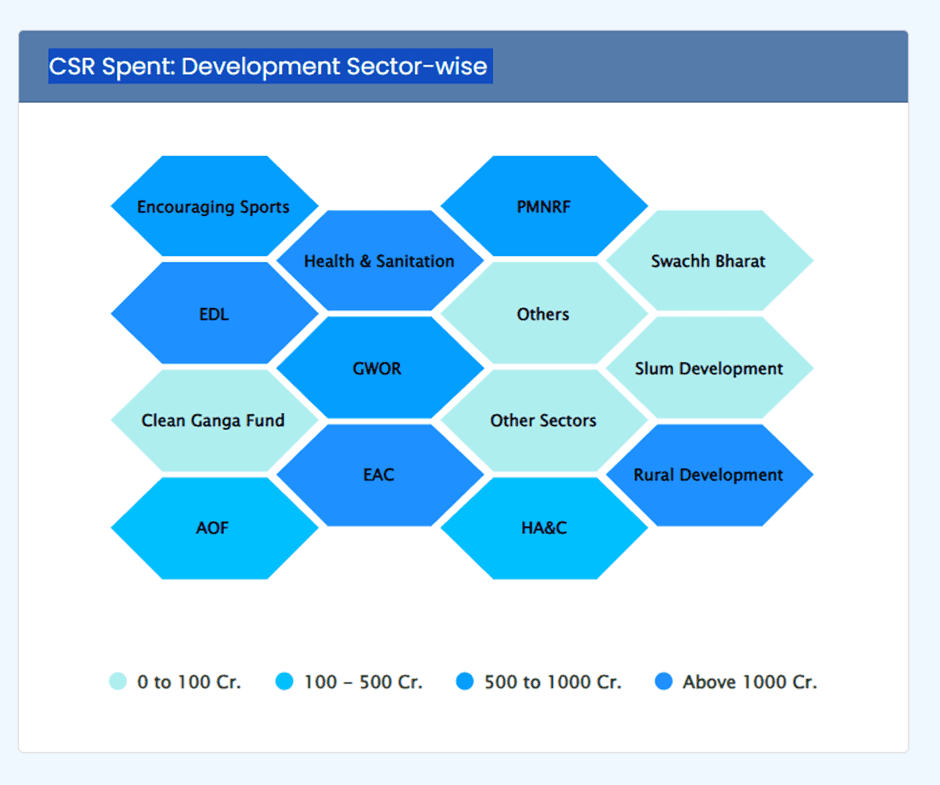
Sector-Wise CSR Distribution
CSR investments in India are directed towards several key sectors, with industries focusing on areas that align with both their business goals and societal needs.
Sector selection is increasingly influenced by auditability, outcome measurement, and alignment with ESG disclosures.
Below is an analysis of the sectors receiving the highest CSR allocations, including education, healthcare, rural development, and environmental sustainability.
1. Education
Education remains the top priority for CSR investments, with major corporations funding projects to enhance access to quality education, vocational training, and digital learning. Companies in IT, manufacturing, and banking are significant contributors.
➤ TCS and Infosys have made substantial investments in education and skill development programs.
2. Healthcare
Healthcare CSR initiatives include funding for hospitals, health camps, disease research, and vaccination drives, particularly in the aftermath of the COVID-19 pandemic. Pharma giants and IT companies are key players in this sector.
➤ Wipro contributed INR 100 crore for COVID-19 relief efforts, including medical supplies and vaccinations.
3. Rural Development
Many companies focus on improving rural livelihoods by providing access to clean water, promoting sustainable farming, and improving education and healthcare. Leading players in rural development include Mahindra & Mahindra, ITC, and Tata Group.
➤ ITC’s Mission Sunehra Kal has empowered rural communities with access to healthcare, education, and livelihood programs.
4. Environment
Environmental sustainability is a growing priority, with companies investing in renewable energy, afforestation, and waste management initiatives. Major contributors to environmental CSR in India include Reliance Industries, L&T, and Hindustan Unilever.
➤ Reliance Industries has undertaken several projects focused on renewable energy and environmental conservation.

Top Companies Leading CSR in India
Corporate Social Responsibility in India is largely shaped by a small group of large conglomerates with the scale, institutional capacity, and governance structures required to deploy CSR funds consistently and at scale. These companies account for a significant share of total CSR expenditure and typically operate through dedicated foundations or long-term implementation partnerships.
Tata Group: Among the largest CSR contributors in India, Tata Group’s CSR efforts are concentrated in education, healthcare, rural development, and livelihoods, supported by long-standing institutional mechanisms.
Reliance Industries: Reliance’s CSR portfolio spans healthcare, education, disaster response, and environmental sustainability, alongside growing investments linked to renewable energy and resource efficiency.
Wipro: Wipro has maintained a strong focus on education, digital literacy, healthcare, and environmental sustainability, with structured programs rather than short-term interventions.
Infosys: Infosys’ CSR initiatives primarily focus on education, skill development, and capacity building, particularly through technology-enabled learning and employability programs.
ITC Limited: ITC’s CSR strategy emphasises sustainable livelihoods, rural development, water stewardship, and environmental conservation, closely aligned with its agricultural and supply-chain footprint.
Together, these organisations illustrate how CSR outcomes tend to improve when programs are treated as long-term, strategic commitments rather than annual compliance exercises.
Key Drivers of CSR in India
CSR in India is shaped by several factors that drive companies to integrate social responsibility into their strategies:
Regulatory Mandates: The Companies Act, 2013 mandates CSR spending for companies meeting certain criteria, making CSR a legal obligation for large businesses.
Consumer Expectations: With consumers prioritizing socially responsible brands, companies are aligning their CSR activities with ethical and sustainable practices to boost brand loyalty.
Government Initiatives: The Indian government encourages CSR through various programs like Swachh Bharat Abhiyan and PM CARES Fund, providing platforms for businesses to contribute to national causes.
Global Standards: International frameworks like the UN SDGs push Indian companies to adopt global CSR standards, especially as they expand into international markets.
Environmental Sustainability: CSR investments are increasingly directed towards environmental initiatives, including renewable energy and waste management, driven by growing climate change concerns.
Corporate Reputation: CSR programs enhance corporate reputation, build consumer trust, and contribute to long-term business success.
Stakeholder Pressure: Shareholders and stakeholders demand greater accountability, pushing companies to invest in CSR and report their impact.
Socio-Economic Needs: CSR addresses India’s socio-economic inequalities, focusing on poverty alleviation, healthcare, education, and rural development.
Employee Engagement: Companies with strong CSR initiatives attract and retain talent, especially from younger generations who value ethical business practices.

Market Opportunities in CSR
As Corporate Social Responsibility in India matures, opportunity is shifting away from simply increasing spend volumes toward how CSR is designed, implemented, and measured. Regulatory clarity under the Companies Act, 2013, combined with rising scrutiny from regulators and stakeholders, has created a more structured CSR ecosystem, as reflected in aggregated disclosures on the government’s CSR reporting platform (csr.gov.in).
Key opportunity areas in India’s CSR landscape include:
1. Sustainability and Climate-Linked Initiatives
CSR investments are gradually expanding beyond afforestation and renewable energy into areas such as water security, waste management, and climate resilience. This shift aligns with India’s broader climate and resource-efficiency priorities and is increasingly reflected in sustainability finance and environmental governance frameworks highlighted by the United Nations Environment Programme (UNEP).
2. Health Systems and Preventive Care
Post-pandemic CSR activity has moved from emergency relief toward health system strengthening, including preventive healthcare, nutrition, and public health infrastructure. Policy analyses note that CSR is increasingly being used to complement public healthcare delivery rather than duplicate short-term interventions.
3. Education, Skilling, and Workforce Readiness
Education remains the largest recipient of CSR funds, but the opportunity lies in linking skilling initiatives to employability and local economic demand. CSR disclosures indicate growing focus on digital learning, vocational training, and capacity building rather than standalone infrastructure projects.
4. Rural Development and Livelihood Resilience
CSR is increasingly being deployed toward livelihood enhancement, water access, and agricultural sustainability, particularly in regions exposed to climate and income volatility. Development institutions such as the World Bank highlight the importance of integrating livelihoods with resilience planning, an area where CSR can play a complementary role.
5. Technology-Enabled CSR and Impact Tracking
There is growing demand for technology-enabled CSR solutions that improve transparency, monitoring, and reporting. Tools for impact measurement, geospatial tracking, and data-driven reporting are increasingly valued as regulators and boards seek verifiable outcomes rather than activity-based reporting.
6. Disaster Preparedness and Climate Risk Response
Rather than reactive disaster relief, CSR opportunities are shifting toward preparedness, early warning systems, and climate risk reduction, aligning with global disaster risk reduction frameworks. This approach reduces long-term costs and improves community resilience.
7. CSR Governance, Advisory, and Reporting Services
As CSR compliance, disclosure, and unspent fund tracking become more stringent, there is rising demand for CSR advisory, program management, and reporting capabilities. This includes third-party monitoring, evaluation, and alignment with ESG disclosures, as highlighted in policy and governance reviews by institutions such as the OECD.
End Note
CSR in India has transitioned from a compliance-driven mandate to a structured development-financing mechanism that plays a growing role in addressing social, environmental, and regional challenges. While education, healthcare, rural development, and environmental sustainability continue to receive the largest share of CSR funding, recent trends indicate a gradual shift toward longer-term programs, outcome-based planning, and stronger implementation oversight.
Looking ahead to 2026, the effectiveness of CSR will be defined less by total expenditure and more by how strategically funds are deployed, particularly in regions facing climate risk, livelihood vulnerability, and infrastructure gaps. Increasing regulatory scrutiny, improved disclosure norms, and rising expectations from stakeholders are pushing companies to move beyond fragmented initiatives toward measurable, multi-year interventions.
As CSR frameworks mature, the focus is expected to move toward impact quality, geographic equity, and transparency, reinforcing CSR’s role not as corporate philanthropy, but as an integral component of sustainable development planning in India.
FAQs
1. What is Corporate Social Responsibility (CSR) in India?
Corporate Social Responsibility (CSR) in India is a statutory requirement under the Companies Act, 2013 that mandates eligible companies to spend a portion of their profits on approved social and environmental activities.
2. What is the current CSR spending in India?
India’s total CSR expenditure stood at approximately ₹29,986 crore in FY 2022–23, reflecting a steady increase in corporate social investment over recent years.
3. What is the 2% CSR rule in India?
The 2% CSR rule requires eligible companies to spend 2% of their average net profits from the previous three financial years on CSR activities listed under Schedule VII of the Companies Act.
4. Which companies are required to comply with CSR laws?
Companies are required to undertake CSR if they meet any one of the following criteria:
Net worth of ₹500 crore or more
Annual turnover of ₹1,000 crore or more
Net profit of ₹5 crore or more
5. What types of activities qualify as CSR in India?
CSR activities in India include investments in education, healthcare, rural development, environmental sustainability, livelihoods, disaster management, and social equity, as defined under Schedule VII of the Companies Act, 2013.
6. How is CSR spending monitored and reported in India?
CSR spending and unspent amounts must be disclosed in a company’s annual report and on the national CSR reporting portal. Companies are also required to form a CSR Committee to oversee planning, implementation, and compliance.
7. How is CSR in India expected to evolve by 2026?
By 2026, CSR in India is expected to shift from spend-focused compliance toward outcome-based, multi-year programs, with stronger emphasis on impact measurement, transparency, and alignment with sustainability and climate priorities.
8. Why is CSR important for sustainable development in India?
CSR supports sustainable development by channeling private sector resources into priority social and environmental challenges, complementing public investment and improving long-term outcomes in areas such as health, education, livelihoods, and climate resilience.
9. Who pioneered CSR in India?
While CSR was formally institutionalised through the Companies Act, 2013, Indian business groups such as the Tata Group and Birla Group were early pioneers of corporate philanthropy and social investment in India.

Other articles




We work with individuals, startups, and NGOs dedicated to forging a sustainable future. Tell us about your mission.

