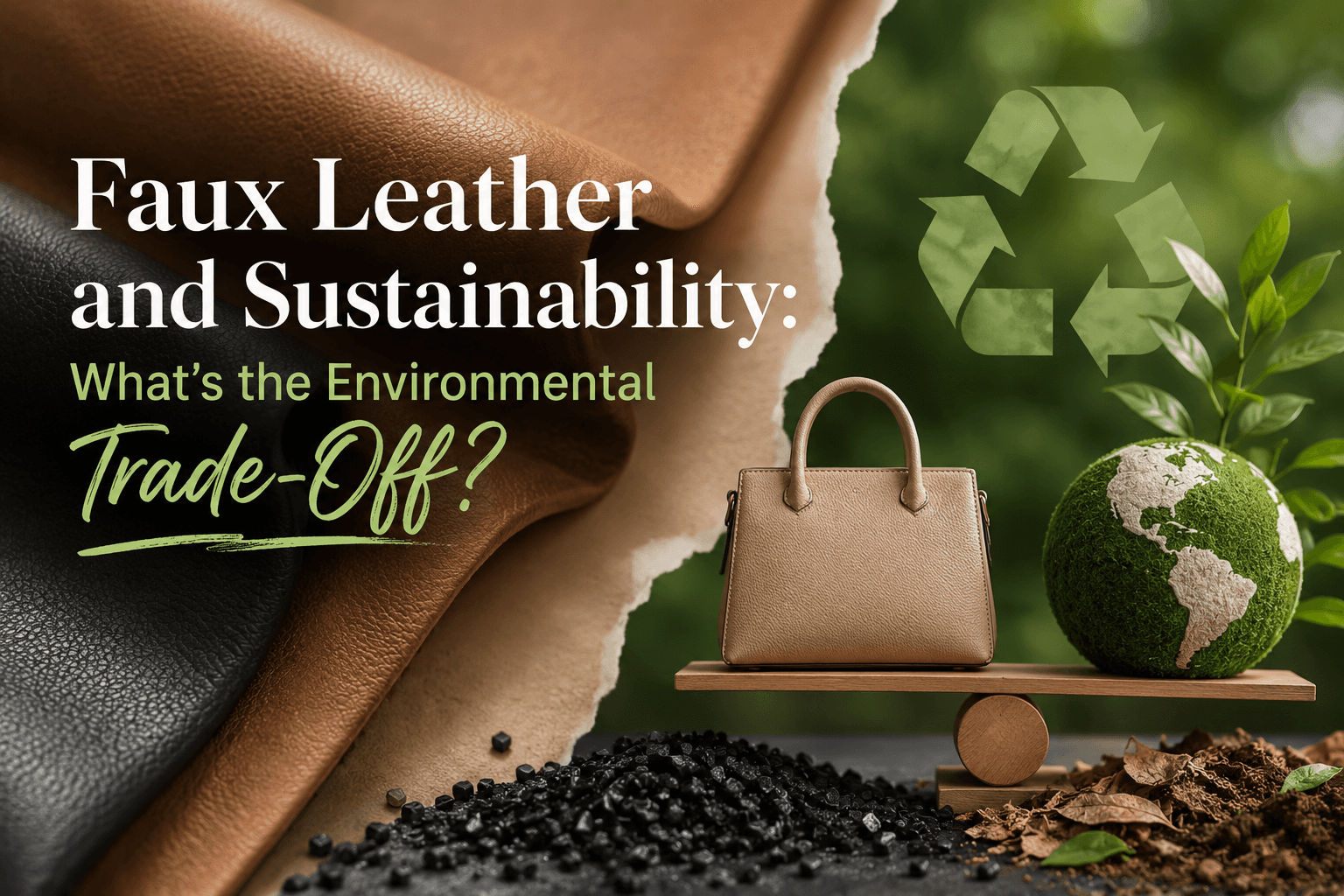
Faux leather has become one of the most widely used materials in modern fashion and consumer products.
From bags and jackets to furniture and automotive interiors, it is now positioned as an affordable and animal-free alternative to traditional leather. In many cases, it is also marketed as a more sustainable choice.
But sustainability conversations around faux leather are more complicated than they first appear.
On one side, faux leather avoids the use of animal hides and the environmental pressures associated with livestock and leather tanning. On the other, most faux leather materials are still heavily dependent on plastics and petrochemical-based production systems.
Which means the question is no longer simply whether faux leather is “better” or “worse.”
The more important question is what environmental trade-offs are actually being made.
What Is Faux Leather?
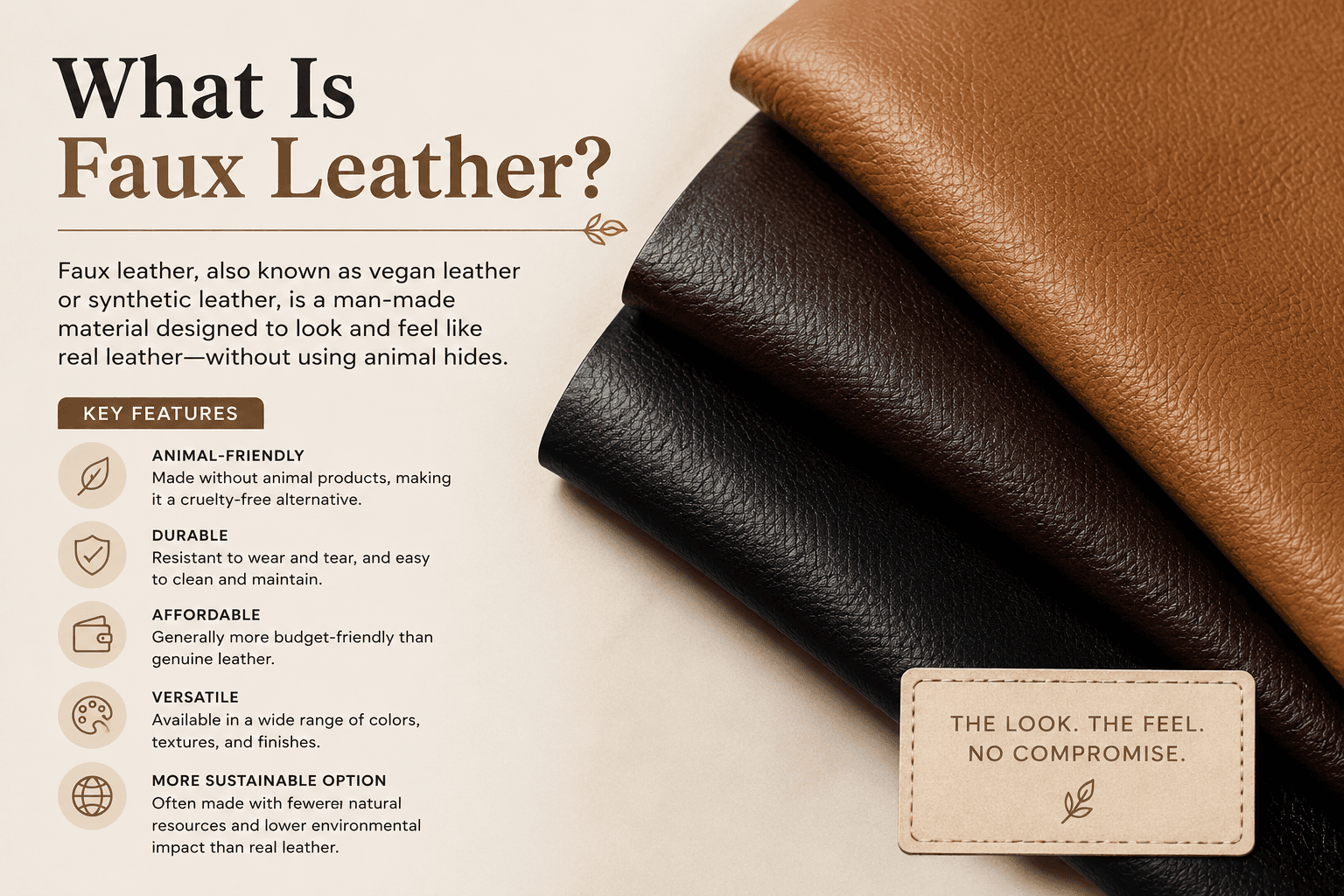
Faux leather is a synthetic material designed to imitate the appearance and texture of real leather.
Most faux leather products are made using:
Polyurethane (PU)
Polyvinyl chloride (PVC)
These materials are typically applied as coatings over fabric backings to create a leather-like surface.
Its popularity is driven by several factors:
Lower cost compared to genuine leather
Easier large-scale manufacturing
Wider accessibility across fashion and furniture industries
Animal-free positioning appealing to changing consumer preferences
Because of this, faux leather has become deeply integrated into fast-moving consumer markets.
Why Faux Leather Is Often Considered Sustainable
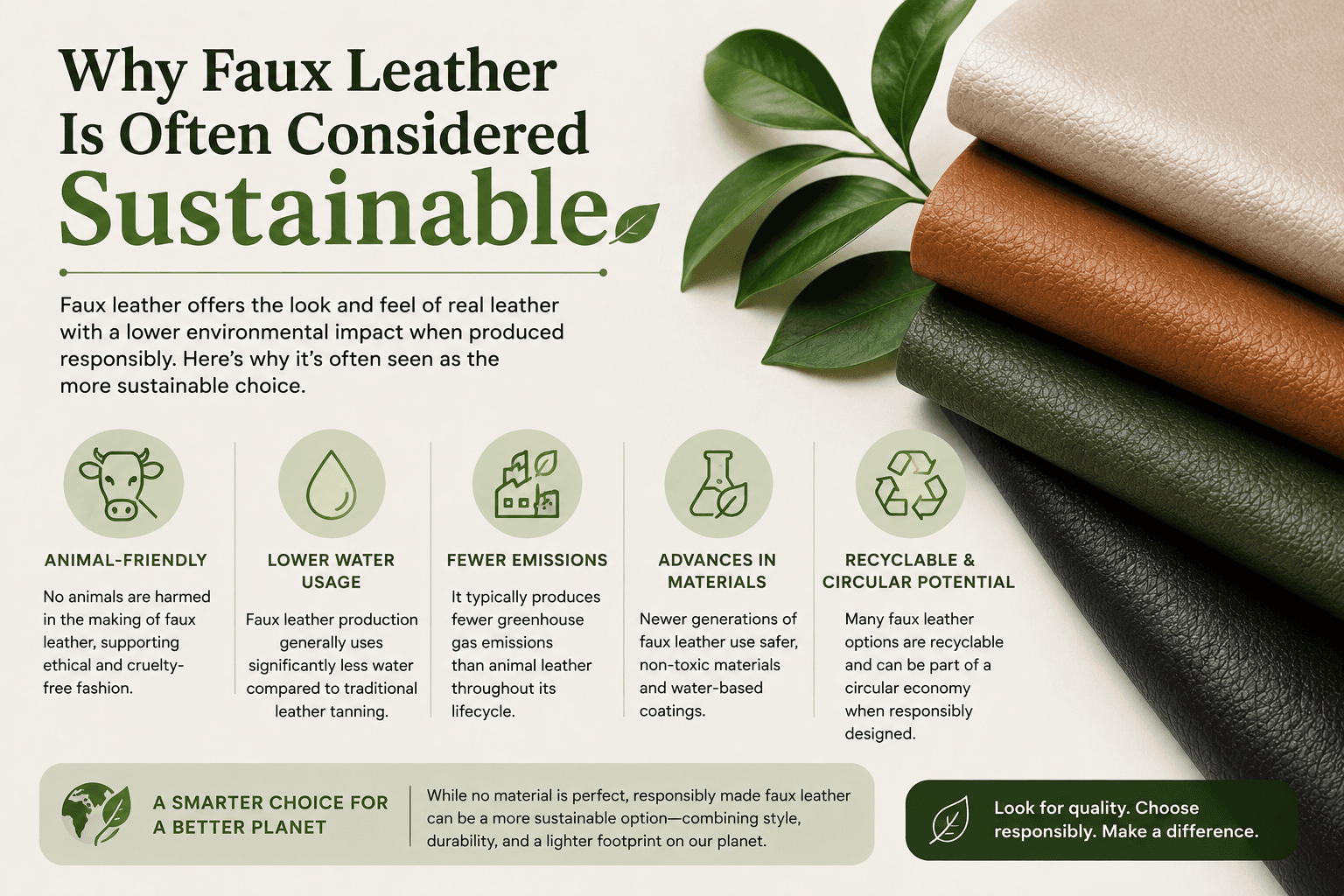
Faux leather gained momentum partly because traditional leather production carries significant environmental and ethical concerns.
Leather production is linked to:
Livestock emissions
Land and water use
Chemical-intensive tanning processes
Waste generation from processing systems
This created demand for alternatives that avoided animal-derived materials altogether.
As sustainability became more central to fashion marketing, synthetic leather alternatives were increasingly positioned as lower-impact options.
And in some ways, they do address specific concerns associated with animal agriculture and tanning.
But sustainability does not depend on a single factor alone.
It depends on the entire lifecycle of the material.
The Plastic Problem Behind Faux Leather
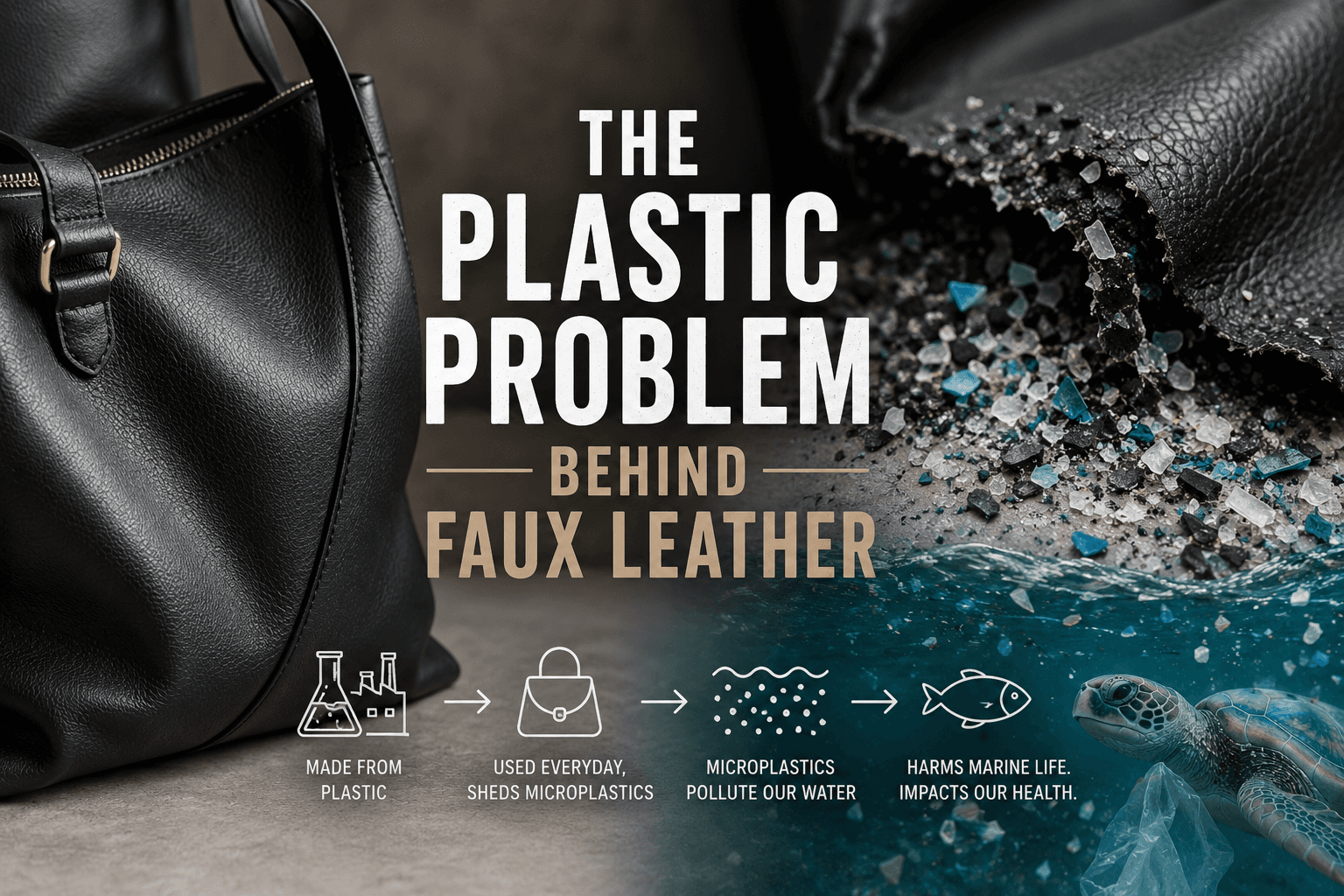
One of the biggest challenges with faux leather is that most versions are fundamentally plastic-based materials.
PU and PVC are derived from fossil fuels and generally do not biodegrade naturally. Over time, these materials contribute to long-term waste accumulation and can release microplastics as products degrade.
According to the United Nations Environment Programme (UNEP), plastic pollution is increasingly recognised as a systemic environmental issue connected to production, consumption, and disposal systems.
This creates a contradiction in sustainability conversations around faux leather.
While it may reduce reliance on animal-derived materials, it can simultaneously increase dependence on synthetic polymers and petroleum-based supply chains.
Which means faux leather cannot automatically be classified as environmentally sustainable simply because it is animal-free.
Durability Changes the Conversation
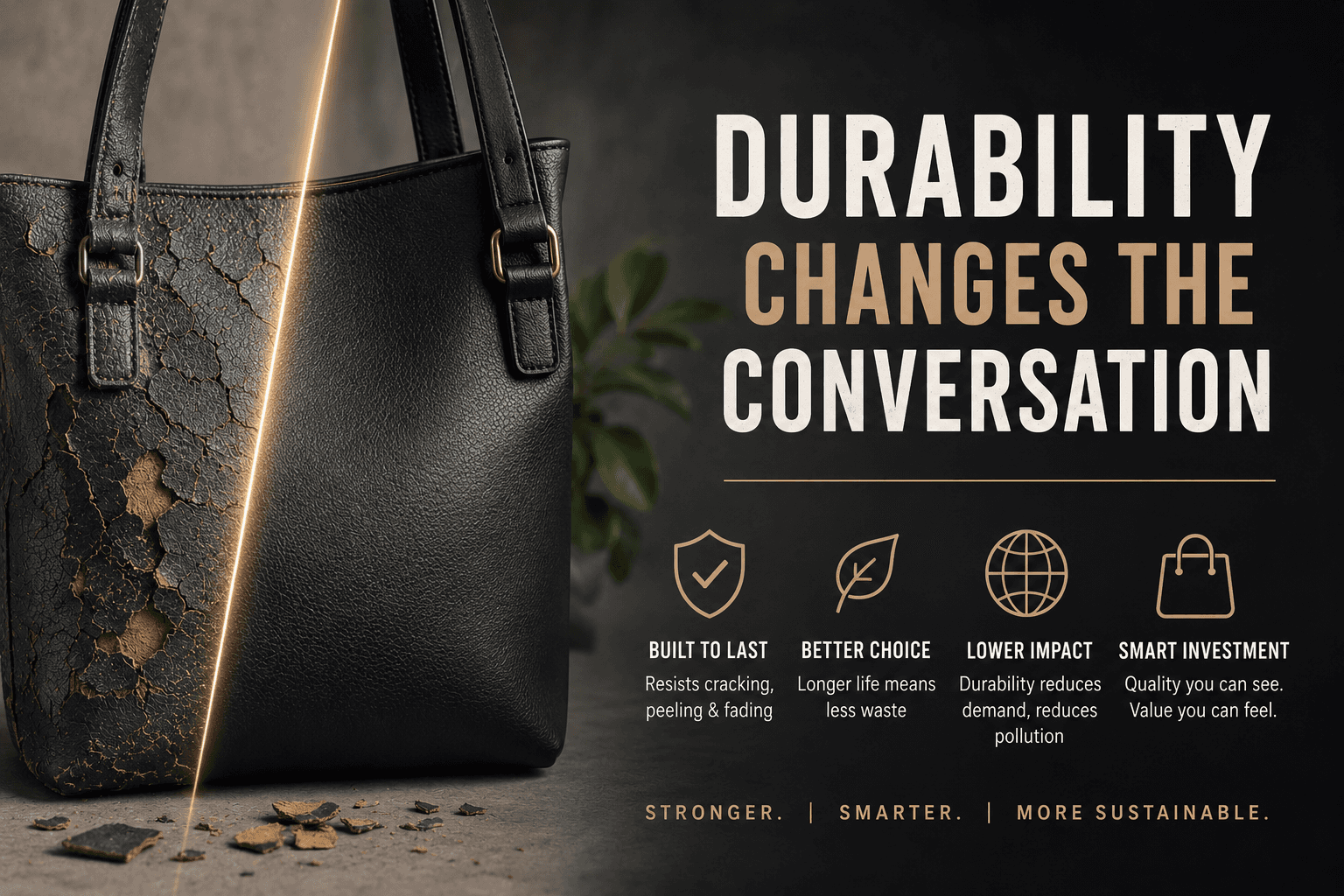
Material impact is not only about what something is made from. It is also about how long it lasts.
A product used consistently for many years creates a different environmental footprint compared to one that is replaced frequently.
This is where the sustainability debate around faux leather becomes more nuanced.
Lower-cost faux leather products are often associated with:
Peeling and cracking over time
Shorter product lifespan
Faster disposal cycles
When products are replaced frequently, waste generation increases regardless of the original material choice.
At the same time, high-quality synthetic materials designed for durability may perform differently from low-cost fast-fashion products.
This highlights an important point:
The sustainability of a material cannot be separated from consumption patterns.
Fast Fashion and Material Turnover
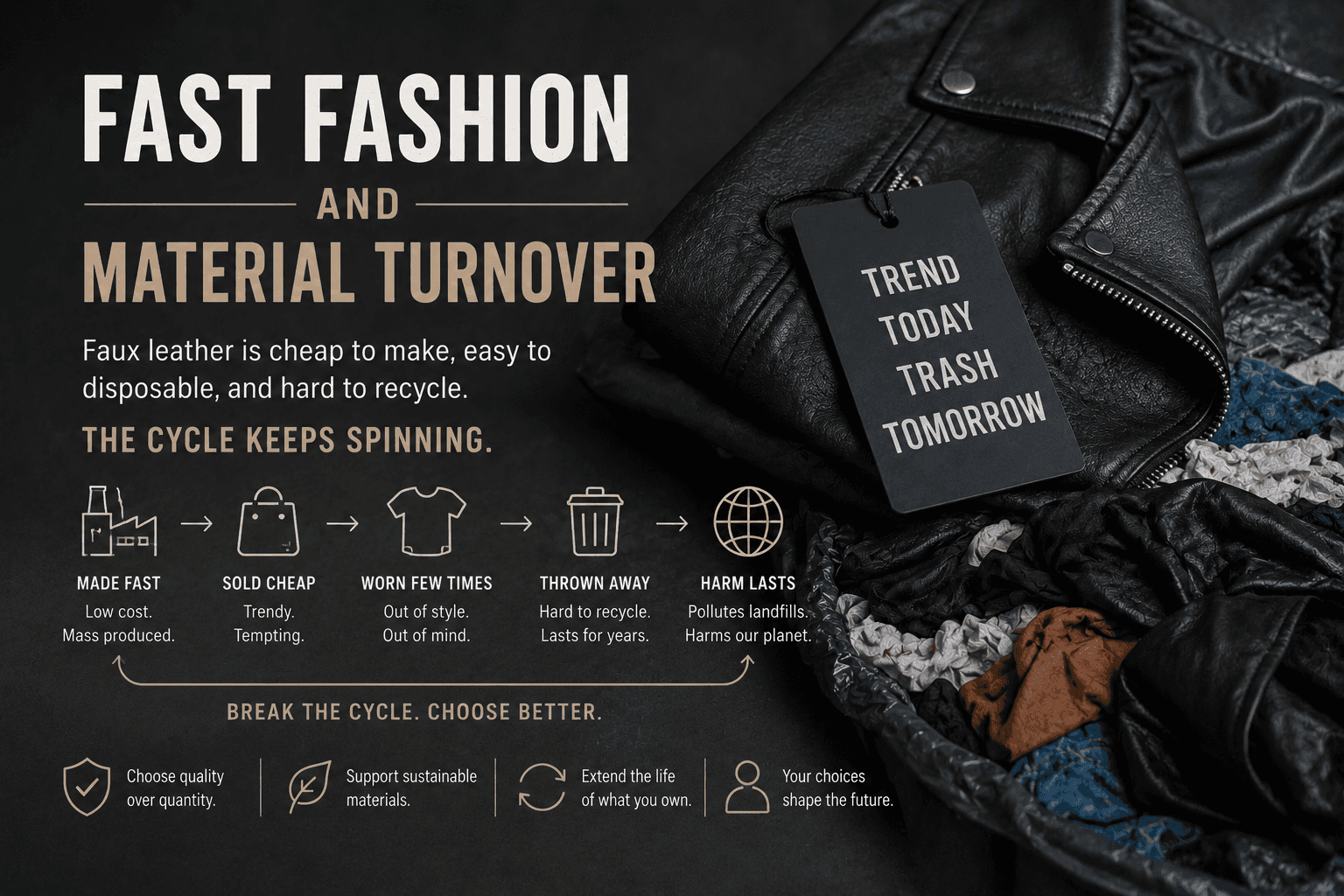
Faux leather is closely linked to the growth of fast fashion systems.
Because it is relatively inexpensive to manufacture, it enables rapid production cycles and lower retail costs. This makes trend-based products more accessible, but also contributes to higher turnover and shorter product lifespans.
Reports from the Ellen MacArthur Foundation continue to highlight how fast fashion models contribute to rising textile waste and material inefficiency globally.
In this context, the environmental issue is not only the material itself.
It is the combination of:
High production volume
Short usage cycles
Limited repairability
Weak recovery systems
Which means sustainability discussions around faux leather must also include the broader economic systems surrounding fashion consumption.
The Recycling Challenge
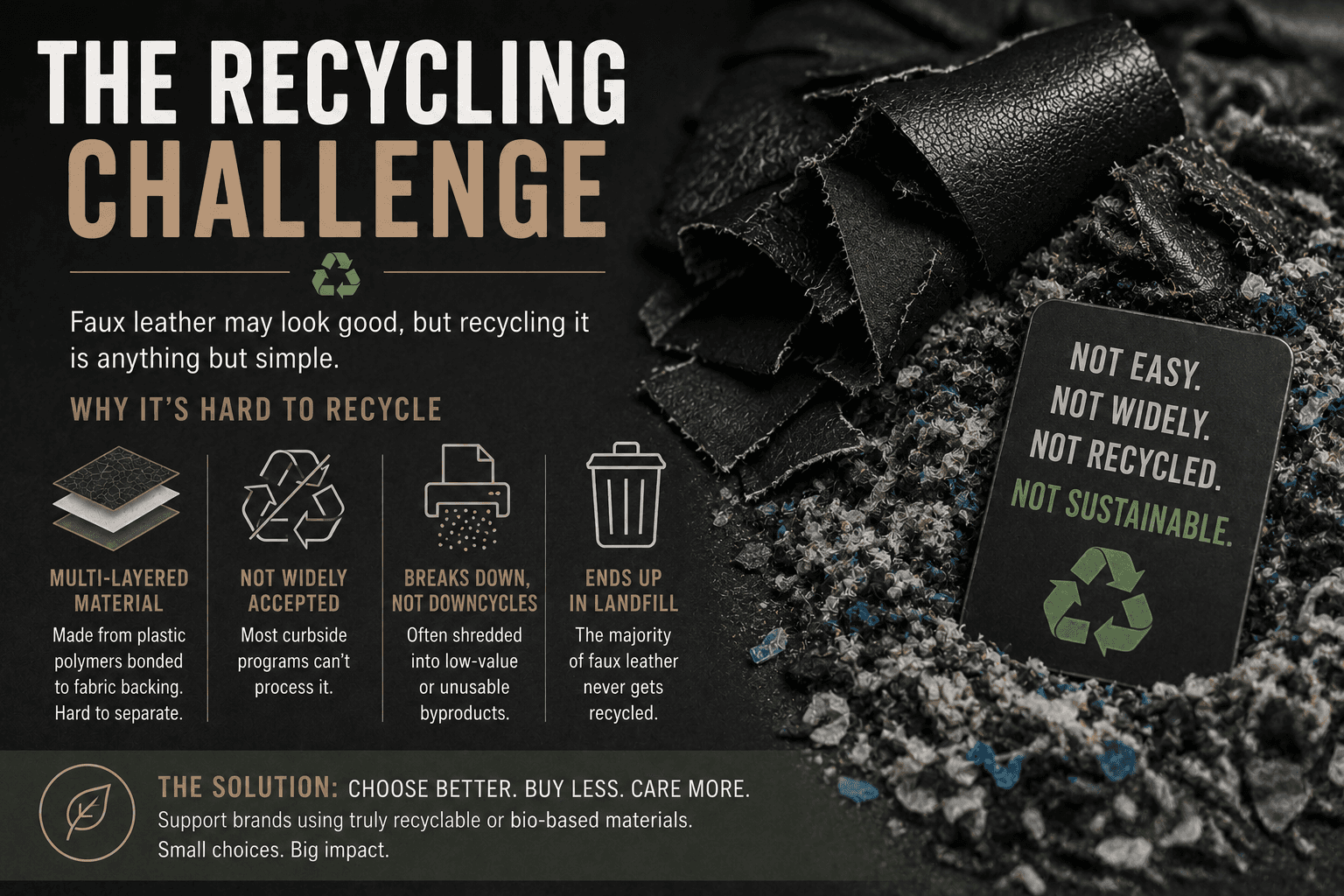
One of the less discussed issues with faux leather is recyclability.
Many faux leather products combine multiple layers:
Plastic coatings
Adhesives
Fabric backings
Chemical finishes
This makes material separation difficult at the end of a product’s life.
As a result, much of this material eventually ends up in landfills or waste streams where recovery becomes economically or technically challenging.
This creates a circular economy problem.
A material that cannot be easily recovered, repaired, or reintegrated into manufacturing systems contributes to long-term waste accumulation, regardless of its original sustainability claims.
The Rise of Bio-Based Alternatives
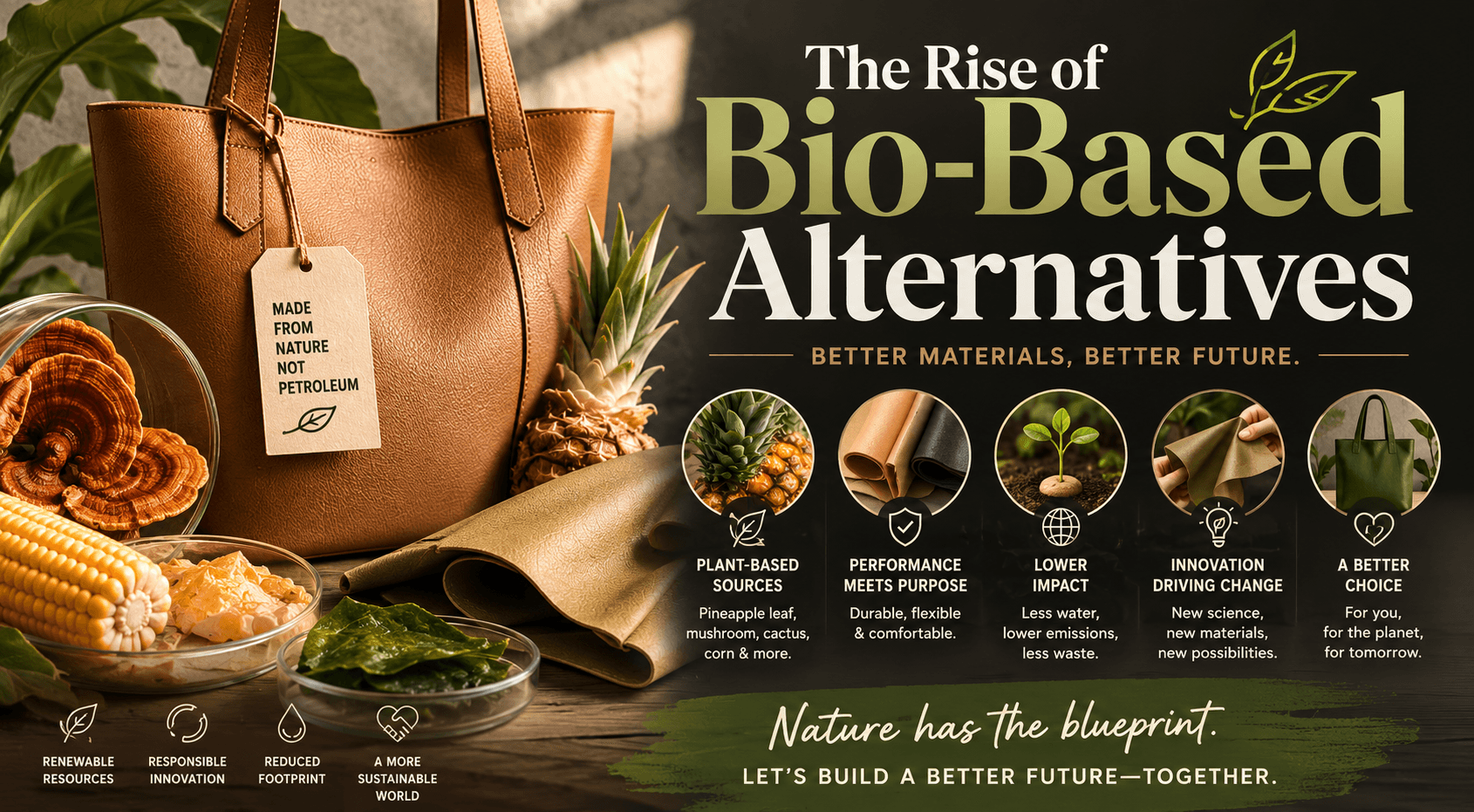
In response to concerns around synthetic materials, companies and material innovators are increasingly exploring plant-based alternatives.
These include materials derived from:
Pineapple fibres
Mushroom mycelium
Apple waste
Cactus
Coconut waste
Brands and innovators such as Pinatex and Malai are part of a growing movement exploring alternatives based on agricultural waste and biomaterials.
These materials are promising because they attempt to reduce dependence on conventional plastics and fossil-fuel-derived feedstocks.
However, many of these alternatives are still evolving. Some continue to use synthetic coatings or binders to improve durability and performance.
Which means even plant-based materials exist on a spectrum rather than as perfect solutions.
Sustainability Is More Than Material Choice
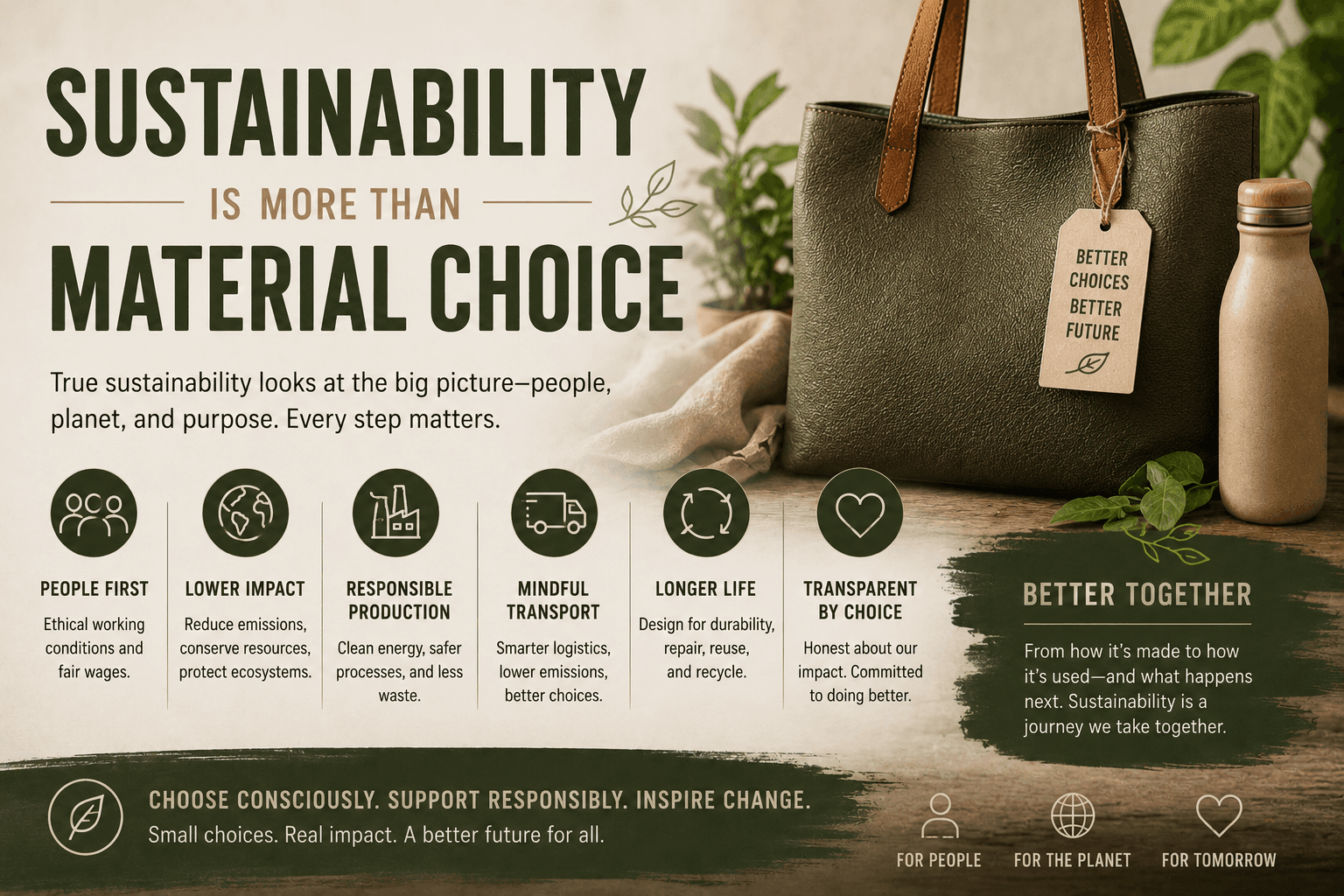
One of the biggest misconceptions in sustainable fashion is the idea that switching materials alone solves the environmental problem.
But sustainability depends on multiple interconnected factors:
Resource extraction
Manufacturing systems
Product lifespan
Repairability
Disposal infrastructure
Consumption behaviour
A lower-impact material used inside a system built around overproduction and rapid disposal still creates environmental strain.
This is why lifecycle thinking is becoming increasingly important in sustainability discussions.
The focus is gradually shifting from:
“What is this made from?”
To:
“How does this material move through its entire lifecycle?”
So, Is Faux Leather Sustainable?
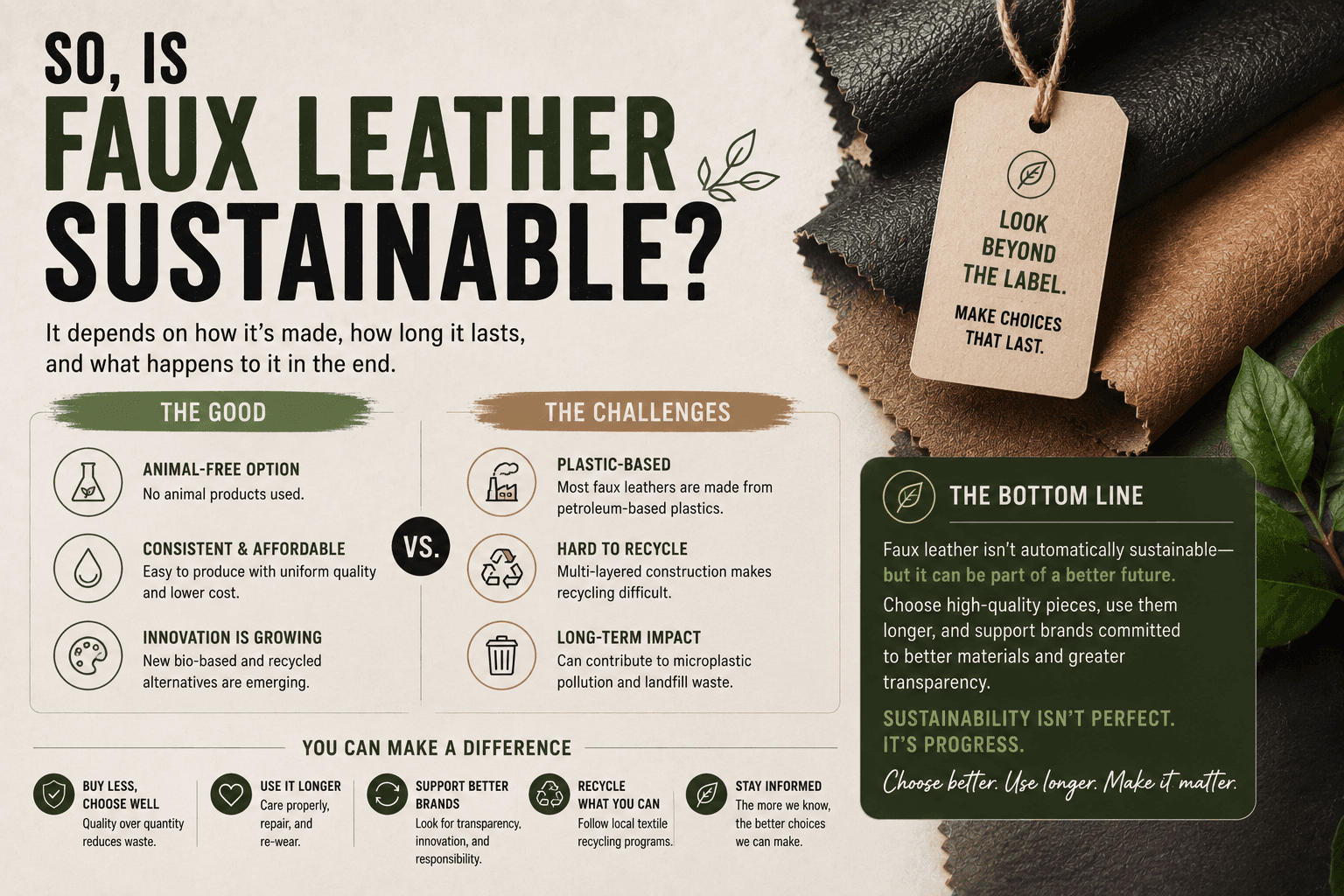
There is no single answer.
Faux leather avoids some of the environmental and ethical concerns associated with traditional leather production. But it also introduces challenges linked to plastics, waste systems, and material recovery.
Its sustainability depends on:
Material composition
Product durability
Manufacturing practices
End-of-life management
Consumer behaviour
Which means faux leather is neither entirely sustainable nor entirely unsustainable.
It exists within a larger trade-off between affordability, performance, ethics, and environmental impact.
And understanding those trade-offs is ultimately more useful than treating any material as a perfect solution.
The Bigger Shift
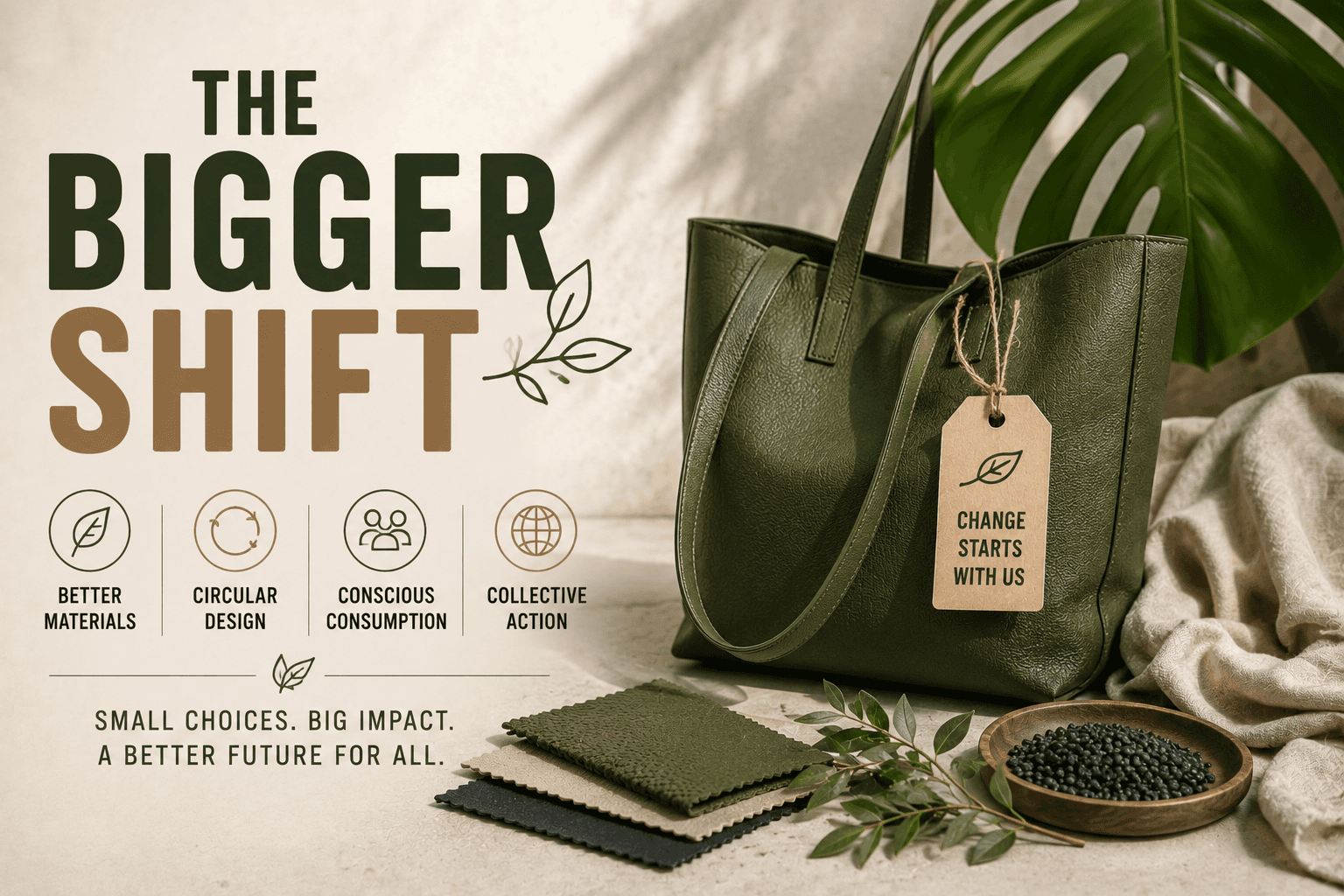
The future of sustainable materials will likely depend less on replacing one material with another and more on rethinking how products are designed, used, repaired, and recovered.
That includes:
Designing for longer lifespans
Reducing unnecessary consumption
Improving recyclability
Supporting circular material systems
Investing in lower-impact alternatives
Because sustainability is rarely determined by labels alone.
It is shaped by systems.
FAQs
1. What is faux leather made of?
Most faux leather is made using synthetic materials such as polyurethane (PU) or polyvinyl chloride (PVC).
2. Is faux leather environmentally friendly?
Faux leather avoids animal-derived materials but often relies on plastics, making its environmental impact more complex.
3. What is the difference between faux leather and real leather?
Real leather is made from animal hides, while faux leather is a synthetic alternative designed to imitate leather.
4. Does faux leather contain plastic?
Yes, most faux leather products contain plastic-based materials such as PU or PVC.
5. Is faux leather biodegradable?
Most conventional faux leather materials are not biodegradable.
6. Why is faux leather popular in fashion?
It is affordable, scalable, animal-free, and widely adaptable across products and industries.
7. What are the environmental concerns with faux leather?
Key concerns include plastic pollution, microplastics, fossil-fuel dependence, and waste management challenges.
8. Are plant-based leather alternatives better?
Some plant-based alternatives reduce dependence on conventional plastics, but many are still evolving and may include synthetic components.
9. Can faux leather be recycled?
Recycling faux leather is difficult because products often combine multiple layered materials that are hard to separate.
10. Is durability important in sustainable materials?
Yes, longer-lasting products generally reduce replacement cycles and overall material consumption.

Other articles


We work with individuals, startups, and NGOs dedicated to forging a sustainable future. Tell us about your mission.