
The transition to a more sustainable economy needs more than ideas, policies, and technology. It also needs money.
Solar parks, electric buses, green buildings, wastewater treatment plants, energy-efficient industries, climate-resilient infrastructure, and sustainable transport systems all require large-scale investment. This is where green bonds become important.
A green bond is a financial instrument used to raise money specifically for projects that have environmental or climate benefits. It works like a regular bond, but with one major difference: the funds raised are meant to be used for eligible green projects.
For governments, companies, banks, and municipalities, green bonds offer a way to finance sustainability projects. For investors, they provide an opportunity to invest in fixed-income products while supporting environmental goals.
Green bonds are not a complete solution to climate change or environmental degradation. But they are an important part of sustainable finance because they connect capital markets with real-world climate and environmental action.
What Is a Green Bond?
A bond is a way for an organisation to borrow money from investors. The organisation issuing the bond receives funds upfront and agrees to repay the amount with interest over a fixed period.
A green bond follows the same basic structure. The difference is that the money raised must be used for green or environmentally beneficial projects.
The World Bank describes green bonds as one of the financing options available to private firms and public entities to support climate and environmental investments.
These projects may include renewable energy, clean transportation, energy efficiency, sustainable water management, pollution control, waste management, biodiversity conservation, and climate adaptation.
In simple terms, a green bond answers one question: can debt finance be used to support environmental progress? The answer is yes, if the bond is designed, used, and reported transparently.
How Do Green Bonds Work?
Green bonds usually follow a clear process.
First, the issuer identifies eligible green projects. These projects must create environmental benefits, such as reducing emissions, improving energy efficiency, conserving water, or building climate resilience.
Second, the issuer creates a green bond framework. This framework explains how projects will be selected, how the money will be managed, and how reporting will be done.
Third, the bond is issued to investors. Investors buy the bond, and the issuer receives capital.
Fourth, the issuer allocates the proceeds to eligible green projects.
Finally, the issuer reports how the money was used and what environmental outcomes were achieved.
The International Capital Market Association’s Green Bond Principles are one of the most widely used voluntary guidelines for green bonds. They focus on four key areas: use of proceeds, project evaluation and selection, management of proceeds, and reporting.
This structure is important because green bonds depend on trust. Investors need to know that the money is actually going where it is supposed to go.
What Can Green Bonds Finance?

Green bonds can finance many types of sustainability projects.
Renewable energy is one of the most common categories. This includes solar, wind, small hydro, biomass, and other clean energy projects. Energy efficiency projects can also qualify, such as efficient lighting, building upgrades, industrial energy savings, and smart energy systems.
Clean transportation is another major area. Electric buses, metro systems, charging infrastructure, railway improvement, and low-emission mobility can all be supported through green finance.
Water and waste projects are also important. Green bonds may fund wastewater treatment, water recycling, rainwater harvesting, sustainable drainage, solid waste management, and pollution prevention.
Some green bonds also support climate adaptation. This includes infrastructure that helps communities manage floods, heatwaves, droughts, coastal risks, and changing rainfall patterns.
India’s Framework for Sovereign Green Bonds includes eligible categories such as renewable energy, energy efficiency, clean transportation, climate change adaptation, sustainable water and waste management, pollution prevention, and biodiversity conservation.
Why Green Bonds Matter
Green bonds matter because climate and sustainability projects need large amounts of long-term finance.
Many green projects have high upfront costs but long-term benefits. A solar plant, wastewater treatment system, or electric transport network may require significant investment before benefits are visible. Green bonds help raise capital for such projects.
They also help bring sustainability into mainstream finance. Instead of treating environmental action as a separate CSR activity, green bonds make it part of investment, borrowing, risk management, and long-term planning.
For governments, green bonds can help finance public infrastructure that supports climate goals. For companies, they can support decarbonisation, resource efficiency, and sustainable operations. For investors, they offer a way to align financial portfolios with environmental objectives.
This is especially relevant for India, where the scale of infrastructure development is large. Roads, buildings, energy systems, water networks, transport systems, and cities are still being built and upgraded. Financing them in a greener way can shape long-term environmental outcomes.
Green Bonds in India
India has been developing its green finance ecosystem over the last few years.
The Government of India introduced its Sovereign Green Bond Framework in 2022 to raise funds for public sector projects that help reduce the carbon intensity of the economy. These sovereign green bonds are issued by the government, and the proceeds are used for eligible green expenditure.
The Securities and Exchange Board of India has also created disclosure requirements for green debt securities. SEBI’s revised disclosure requirements aim to improve transparency around how green bonds are issued and reported.
This matters because India’s sustainability transition will require finance across sectors such as renewable energy, mobility, waste, water, buildings, and industrial decarbonisation.
Green bonds can help move capital toward these sectors, but the quality of the bond depends on how clearly the issuer defines, tracks, and reports the use of funds.
Green Bonds vs Regular Bonds

A regular bond raises money for general purposes. The issuer may use the money for operations, expansion, debt refinancing, or other financial needs.
A green bond raises money for specific environmental purposes. The issuer must identify eligible green projects and report on how the proceeds are used.
Aspect | Regular Bond | Green Bond |
Purpose | General financing | Environmental or climate projects |
Use of funds | Flexible | Restricted to eligible green projects |
Reporting | Financial reporting | Financial and environmental reporting |
Investor interest | Financial return | Financial return plus environmental alignment |
Key risk | Credit risk | Credit risk plus greenwashing risk |
This does not mean green bonds are automatically safer or better investments. Investors still need to assess the issuer’s financial strength, repayment ability, and credibility. The “green” label explains the use of funds, not a guarantee of financial performance.
The Risk of Greenwashing
The biggest concern with green bonds is greenwashing.
A bond may be labelled green, but the actual environmental benefit may be weak, unclear, or poorly reported. In some cases, projects may be only marginally green or may not deliver the claimed outcomes.
This is why transparency is essential. Issuers should clearly explain which projects are eligible, how funds are allocated, what environmental benefits are expected, and how outcomes will be reported.
SEBI has also issued dos and don’ts to avoid greenwashing in green debt securities. This reflects a larger concern in sustainable finance: labels alone are not enough.
For green bonds to be credible, they need proper governance, project selection, tracking of proceeds, impact reporting, and preferably external review or assurance.
What Makes a Green Bond Credible?
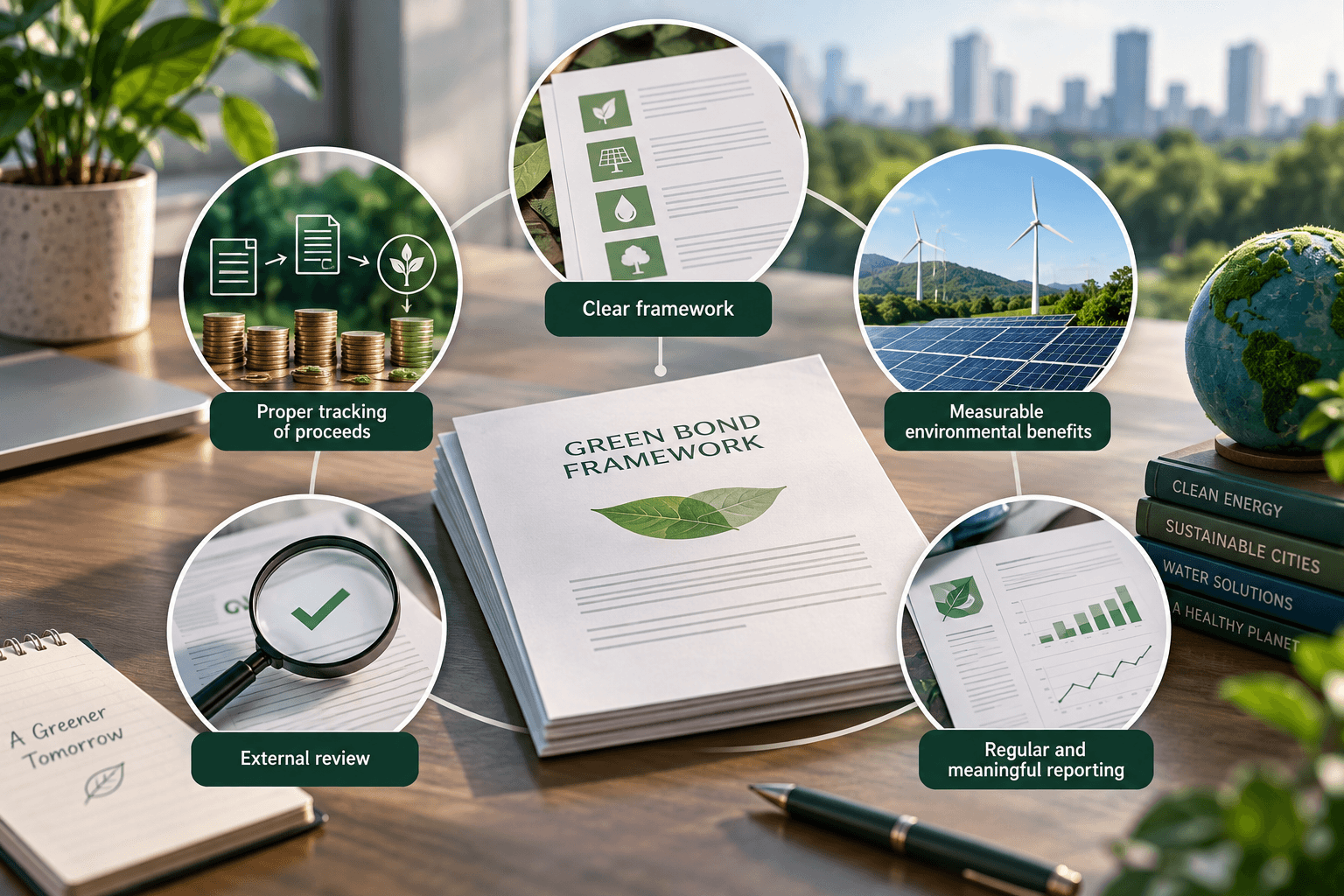
A credible green bond should have a clear framework. The issuer should explain what the money will be used for and why those projects qualify as green.
The projects should create measurable environmental benefits. For example, a renewable energy project may report clean energy generation, while a water project may report volume of water treated or conserved.
The proceeds should be tracked properly. Investors should be able to understand whether funds were allocated to eligible projects.
Reporting should be regular and meaningful. It should not only say that money was spent, but also explain the impact created wherever possible.
External review can also strengthen credibility. Independent assessment helps investors and stakeholders trust that the bond aligns with recognised standards.
Are Green Bonds Enough?
Green bonds are useful, but they are not enough on their own.
A company can issue a green bond for one project while continuing unsustainable practices elsewhere. A government can finance green infrastructure while still needing broader policy changes. An investor can buy green bonds but still hold high-emission assets in the same portfolio.
This is why green bonds should be seen as one part of a wider sustainability strategy.
They work best when they are linked to serious climate goals, strong governance, measurable outcomes, and long-term transition plans.
Green bonds can finance the transition, but they cannot replace the transition itself.
Conclusion

Green bonds are an important tool in sustainable finance. They help governments, companies, and institutions raise money for projects that support climate action, environmental protection, and resource efficiency.
For India, green bonds can play a meaningful role in financing renewable energy, clean transport, water systems, waste management, energy efficiency, and climate-resilient infrastructure.
But credibility matters. A green bond is only as strong as the projects it funds, the transparency behind it, and the impact it delivers.
As sustainability becomes central to business and policy, green bonds can help direct capital toward better outcomes. But they must be used carefully, reported honestly, and supported by real environmental action.
In the end, green bonds are not just about raising finance. They are about asking a deeper question: how can money be used to build a more sustainable future?
FAQs
1. What are green bonds?
Green bonds are bonds used to raise money specifically for environmental or climate-related projects.
2. How do green bonds work?
An issuer raises funds through a bond and uses the proceeds for eligible green projects such as renewable energy, clean transport, or water management.
3. What can green bonds finance?
Green bonds can finance renewable energy, energy efficiency, clean transportation, waste management, water projects, green buildings, and climate adaptation.
4. Who can issue green bonds?
Governments, companies, banks, municipalities, and financial institutions can issue green bonds.
5. How are green bonds different from regular bonds?
Regular bonds can fund general expenses, while green bonds must fund specific environmental or climate-benefit projects.
6. Why are green bonds important?
Green bonds help direct capital toward sustainability projects and support the transition to a low-carbon economy.
7. Are green bonds safe investments?
Green bonds still carry financial risks like regular bonds. Investors must assess the issuer’s credibility, repayment ability, and project transparency.
8. What is greenwashing in green bonds?
Greenwashing happens when a bond is labelled green but does not deliver clear, measurable, or credible environmental benefits.
9. What makes a green bond credible?
A credible green bond has clear project criteria, transparent fund allocation, regular reporting, measurable impact, and preferably external review.
10. Are green bonds useful for India?
Yes. Green bonds can help India finance renewable energy, clean transport, water systems, waste management, and climate-resilient infrastructure.

Other articles




We work with individuals, startups, and NGOs dedicated to forging a sustainable future. Tell us about your mission.

