

Contents
Main Menu
Operations management sits at the core of how organizations actually function. It is the discipline that determines whether strategic intent translates into reliable execution—on the factory floor, in hospitals, across supply chains, and within digital service platforms.
At its essence, operations management focuses on designing, running, and continuously improving the systems that transform inputs—people, materials, capital, and information—into outputs that customers depend on. When done well, it reduces friction, controls costs, stabilises quality, and enables organizations to scale without chaos. When done poorly, even the strongest business strategy fails at the point of delivery.
Across industries, the importance of operations management has increased as businesses face tighter margins, volatile demand, supply chain disruptions, and rising sustainability expectations. Research and practice in operations and supply chain management consistently show that organizations with strong operational capabilities outperform peers on efficiency, resilience, and long-term competitiveness, particularly in complex and resource-constrained environments.
This blog examines what operations management really entails, how it functions across different industries, and why it has become a strategic lever rather than a back-office function. Rather than treating operations as a checklist of processes, the focus here is on how organizations design systems that work under real-world constraints.
What is Operations Management?
Operations management is the discipline of designing, overseeing, and optimizing the processes involved in producing goods or delivering services. It ensures that all resources—including labor, materials, technology, and time—are used efficiently and effectively to meet organizational goals.
Think of operations management as the behind-the-scenes engine that keeps a business running smoothly. It focuses on transforming inputs (like raw materials, human effort, and capital) into outputs (finished products or services) while maintaining quality and minimizing costs.
Key elements of operations management include:
- Planning: Setting goals, forecasting demand, and preparing resources to meet objectives.
- Organizing: Arranging tasks, assigning responsibilities, and coordinating efforts across teams.
- Executing: Implementing plans, monitoring progress, and ensuring workflows are uninterrupted.
- Improving: Continuously analyzing and enhancing processes to boost efficiency and adapt to market changes.
Operations management is vital for any industry, whether it’s manufacturing, healthcare, retail, or technology. For example:
- In manufacturing, it involves streamlining assembly lines and managing supply chains.
- In healthcare, it ensures that hospitals are adequately staffed and that patients receive timely care.
- In retail, it focuses on inventory control, store layouts, and customer service.
Ultimately, operations management bridges the gap between strategy and execution, ensuring that organizations can deliver on their promises while staying competitive in their markets.

Operations Management by Industry: How Execution Differs Across Contexts
Operations management does not look the same across industries. The core objective—reliable transformation of inputs into outputs—remains constant, but the constraints, risks, and performance priorities vary sharply depending on the operating environment. Understanding these differences is critical for designing systems that actually work in practice.
1. Manufacturing: Flow, Quality, and Cost Discipline
In manufacturing, operations management is centred on process stability, throughput, and defect reduction. The primary challenge is balancing cost efficiency with consistent quality at scale.
Key operational priorities include:
- Production planning and capacity utilisation
- Inventory control and supplier coordination
- Quality assurance and process standardisation
Lean manufacturing systems such as the Toyota Production System demonstrate how statistical process control, just-in-time inventory, and continuous improvement can reduce waste while maintaining reliability, as documented extensively in operations research and industry case studies.
Operational risk: Minor process deviations can cascade into large-scale quality failures or costly downtime.
2. Healthcare: Capacity, Variability, and Patient Outcomes
Healthcare operations operate under high uncertainty and ethical constraints. Demand is unpredictable, service cannot be inventoried, and failure has human consequences.
Operations management focuses on:
- Staff scheduling and capacity planning
- Patient flow and waiting-time reduction
- Equipment availability and service reliability
Hospitals increasingly apply operations research and queueing theory to improve patient throughput and resource utilisation without compromising care quality, an approach widely studied in health systems management literature.
Operational risk: Poor capacity planning directly affects patient safety and outcomes.
3. Retail and E-commerce: Demand Volatility and Fulfilment Speed
Retail operations must manage high demand variability, short product life cycles, and intense service-level expectations.
Core operational levers include:
- Demand forecasting and replenishment cycles
- Warehouse and last-mile logistics optimisation
- Inventory positioning across channels
Large retailers rely heavily on predictive analytics and distribution network design to align stock levels with local demand patterns, a practice central to modern retail operations management.
Operational risk: Forecast errors translate quickly into stockouts, excess inventory, or margin erosion.
4. Technology and Digital Services: Reliability at Scale
In technology-driven businesses, operations management extends beyond physical production to include system uptime, deployment reliability, and service continuity.
Operational focus areas include:
- Infrastructure scalability and system resilience
- Release management and incident response
- Monitoring and performance optimisation
Practices such as Site Reliability Engineering (SRE) formalise operations management for digital systems, balancing innovation speed with service reliability, as outlined by large-scale technology operators.
Operational risk: System failures scale instantly, impacting millions of users simultaneously.
5. Logistics and Supply Chains: Coordination Under Disruption
Logistics operations are defined by interdependence across suppliers, transport, warehousing, and distribution. Operations management here is about coordination, visibility, and risk mitigation.
Key priorities include:
- Network design and route optimisation
- Inventory buffering and lead-time control
- Disruption response and contingency planning
Global supply chain disruptions in recent years have reinforced the importance of resilient operations design over pure cost minimisation, a shift analysed extensively in supply chain research.
Operational risk: Failures propagate across the entire value chain, not just one firm.
6. Services and Hospitality: Consistency at the Human Interface
Service operations depend heavily on human performance and customer perception. Unlike manufacturing, quality is co-produced with the customer.
Operational priorities include:
- Workforce training and service design
- Demand smoothing and capacity alignment
- Standardisation without loss of flexibility
Service operations management research highlights the importance of process design in delivering consistent experiences despite human variability.
Operational risk: Variability in service delivery directly affects brand trust and repeat business.
Why this industry lens matters
Operations management fails when organizations apply generic best practices without context. What works in manufacturing can break healthcare systems; what works in digital platforms may be irrelevant in asset-heavy logistics. Effective operations management begins with understanding industry-specific constraints, then designing systems that absorb variability rather than collapse under it.
Role of Operations Management in an Organization
Operations management plays a central role in translating organizational intent into consistent, repeatable outcomes. Rather than operating as a support function, it shapes how effectively an organization allocates resources, absorbs uncertainty, and delivers value at scale.
1. Converting Strategy into Execution
Operations management determines whether strategic priorities—such as cost leadership, responsiveness, or quality differentiation—can be executed reliably. Research on execution failure consistently shows that weak operational design, not flawed strategy, is the most common reason organizations underperform (https://hbr.org/2015/01/why-strategy-execution-unravels-and-what-to-do-about-it).
Core role: Align operational systems with strategic intent.
2. Managing Trade-offs Under Constraints
Every organization faces trade-offs between cost, speed, flexibility, and quality. Operations management provides the structure to make these trade-offs explicit and manageable, rather than allowing them to emerge as crises.
Operations research literature highlights that organizations outperform peers when they design processes around known constraints instead of attempting to optimize all dimensions simultaneously (https://www.sciencedirect.com/topics/business-economics/operations-management).
Core role: Design systems that perform well under real constraints.
3. Stabilising Quality and Reliability
Operations management establishes the controls that ensure outputs meet expected standards despite variability in inputs, demand, or human performance. This applies equally to manufacturing defects, service delays, and system downtime.
Empirical studies in operations and quality management show that consistency and reliability are among the strongest drivers of customer trust and long-term performance (https://journals.sagepub.com/doi/10.1177/1094670504273847).
Core role: Reduce unwanted variation in outcomes.
4. Enabling Efficient Resource Allocation
Decisions about capacity, staffing, inventory, and asset utilisation are operational decisions with direct financial consequences. Operations management ensures that resources are deployed where they create the most value, rather than being locked into inefficient or legacy structures.
Consulting and academic research increasingly link operational efficiency with organizational resilience, particularly in volatile or supply-constrained environments (https://www.mckinsey.com/capabilities/operations/our-insights/operations-excellence-a-strategy-for-the-volatile-world).
Core role: Allocate scarce resources efficiently and adaptively.
5. Supporting Scalability and Growth
Growth introduces complexity. Operations management determines whether an organization can scale without degrading quality, service levels, or cost discipline. Scalable operations rely on process clarity, performance measurement, and feedback loops rather than heroic effort.
Studies of high-growth firms show that operational discipline is a stronger predictor of sustained performance than innovation alone (https://hbr.org/2014/01/the-capitalists-dilemma).
Core role: Enable growth without operational breakdown.
6. Strengthening Risk and Resilience
Operational systems are often the first point of failure during disruptions—whether due to supply shocks, labour shortages, or system outages. Operations management builds resilience by identifying vulnerabilities and designing buffers, redundancies, and response protocols.
Post-pandemic supply chain research underscores the importance of resilience-oriented operations over pure cost minimisation (https://www.mckinsey.com/capabilities/operations/our-insights/global-supply-chains-in-a-post-pandemic-world).
Core role: Anticipate and absorb operational shocks.
Why this role matters
Organizations do not compete solely on ideas or strategy—they compete on execution quality. Operations management is the discipline that governs execution, determining whether plans survive contact with reality.
The Operations Management Process
The operations management process is a systematic approach to managing resources, workflows, and activities to produce goods or deliver services efficiently. This process ensures that an organization’s operations align with its strategic goals while maintaining quality and optimizing costs. Below is a breakdown of the key stages in the operations management process:
1. Planning
This is the foundation of operations management. It involves:
- Setting clear objectives and determining the resources needed.
- Forecasting demand for products or services.
- Developing strategies to meet customer expectations within budget and time constraints.
2. Organizing
Once plans are in place, the next step is organizing:
- Assigning tasks and responsibilities to teams or individuals.
- Allocating resources like equipment, materials, and budgets.
- Designing workflows to ensure smooth operations.
3. Staffing
People are a critical component of any operation. Staffing includes:
- Recruiting and hiring skilled employees.
- Providing training to enhance their capabilities.
- Ensuring workforce availability to meet operational demands.
4. Leading
Leadership ensures that operations are carried out as planned. This involves:
- Motivating employees to perform at their best.
- Resolving conflicts and addressing challenges.
- Communicating goals and expectations clearly.
5. Controlling
Controlling ensures that operations stay on track. It includes:
- Monitoring performance through key metrics and benchmarks.
- Identifying deviations from the plan and implementing corrective actions.
- Evaluating outcomes to improve future processes.
What Does an Operations Manager Do?
An Operations Manager is responsible for overseeing the day-to-day activities of a business or organization to ensure smooth and efficient operations. Their primary role is to manage resources, processes, and teams to optimize productivity, meet business goals, and improve performance. Here are the main duties of an Operations Manager:
- Process Management: Streamlining operational processes to ensure efficiency and effectiveness.
- Resource Allocation: Ensuring the proper allocation of resources, including personnel, equipment, and materials.
- Team Management: Supervising and leading teams, ensuring they meet performance standards and achieve company goals.
- Budgeting and Cost Control: Managing budgets and controlling operational costs to maintain profitability.
- Quality Assurance: Ensuring the quality of products or services meets company standards and customer expectations.
- Supply Chain Management: Overseeing inventory, procurement, and distribution processes.
- Problem Solving: Identifying and addressing operational challenges or bottlenecks.
- Reporting and Analysis: Monitoring performance metrics and generating reports to inform decision-making and drive improvements.

Operations Management Examples: The Process
Operations management involves a variety of processes that ensure the efficient functioning of an organization. Here are some common processes with operations management examples:
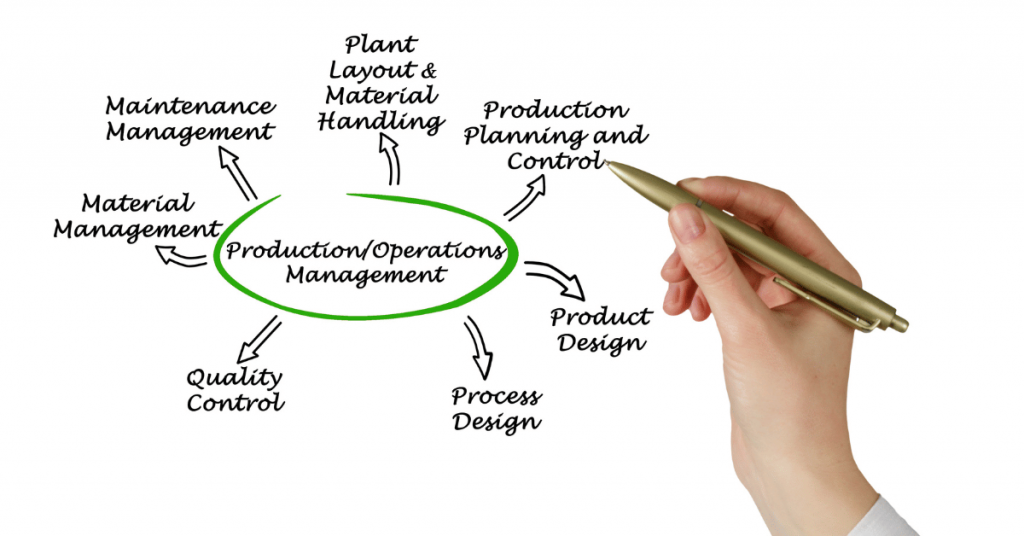
- Supply Chain Management: This process involves managing the flow of goods and services from suppliers to customers. It includes procurement, logistics, inventory management, and distribution.
- Production Planning: This process focuses on scheduling production to meet demand efficiently while optimizing resources, such as labor, equipment, and raw materials.
- Quality Control: Ensuring products or services meet predefined quality standards through regular inspections, testing, and corrective actions. This process helps maintain customer satisfaction and compliance with regulations.
- Inventory Management: Involves monitoring and controlling the inventory levels of raw materials, work-in-progress, and finished goods to avoid stockouts or overstocking while minimizing costs.
- Process Improvement (Continuous Improvement): Operations managers regularly review and improve operational processes to increase efficiency, reduce waste, and enhance product quality, often using methodologies like Lean or Six Sigma.
- Capacity Planning: This process involves determining the production capacity needed to meet demand. It ensures that there are enough resources, facilities, and equipment to produce goods or services on time.
- Resource Allocation: Allocating human, financial, and physical resources in a way that maximizes efficiency and aligns with organizational goals. It includes staffing, budgeting, and equipment management.
- Demand Forecasting: Predicting future customer demand to ensure the organization can meet it without overproducing or underproducing, helping manage inventory levels and production schedules.
- Maintenance Management: Ensuring that machinery and equipment are maintained and repaired regularly to minimize downtime and avoid disruptions to production.
- Risk Management: Identifying and managing potential risks to operations, such as supply chain disruptions, equipment failures, or regulatory changes, and developing contingency plans.

How Leading Companies Apply Operations Management in Practice
Real-world operations management is best understood through specific execution choices, not brand narratives. The following examples illustrate how organizations apply core operational principles across different contexts.
1. Supply Chain Management - Apple
Apple is known for its efficient supply chain management. They maintain close relationships with suppliers worldwide, ensuring they have the raw materials needed for production. Apple uses a just-in-time (JIT) inventory system, ensuring that products are manufactured based on demand forecasts, minimizing excess inventory and reducing costs.
2. Production Planning - Toyota
Toyota uses the Toyota Production System (TPS), which focuses on lean manufacturing and waste reduction. A key aspect is Jidoka (automation with a human touch), which allows workers to stop the production line if there’s an issue, ensuring quality control. Production is planned based on customer demand, and flexible manufacturing systems allow Toyota to produce different models in a streamlined process.
3. Quality Control - McDonald's
McDonald’s has a well-established quality control process across its global network. Each restaurant must adhere to strict quality standards for food preparation and service. For instance, McDonald’s uses detailed checklists for food safety, ensuring that cooking temperatures and food handling procedures meet health regulations and customer expectations consistently.
4. Inventory Management - Amazon
Amazon employs advanced inventory management systems and robotics in its warehouses to ensure efficient stock control. With millions of items in inventory, Amazon uses algorithms to predict demand and optimize stock levels, reducing the chances of stockouts or overstocking, and speeding up order fulfillment.
5. Process Improvement (Continuous Improvement) - GE (General Electric)
GE is known for its commitment to continuous improvement through its Six Sigma program. In the 1990s, GE’s CEO Jack Welch made Six Sigma a central part of the company’s strategy to eliminate defects and improve operational efficiency. Engineers at GE would work to improve processes by analyzing data, finding areas of waste, and proposing solutions that could save the company millions of dollars.
Mission Sustainability: Operational Efficiency Services
Mission Sustainability focuses on optimizing business operations to achieve both environmental and operational goals. These services help organizations improve resource utilization, reduce waste, and integrate sustainable practices across their operations. From energy management and waste reduction to supply chain sustainability and eco-friendly technology integration, our approach ensures that businesses not only enhance efficiency but also contribute to a greener, more sustainable future. Their services include:
- Process Optimization: Pinpointing inefficiencies and fixing them to save time and resources.
- Resource Management: Advising on smarter ways to use materials, energy, and manpower.
- Sustainability Practices: Introducing eco-friendly methods to improve operational efficiency without harming the planet.
These services not only help businesses grow but also ensure they contribute positively to society. To learn more, visit Mission Sustainability.

Why is Operations Management Important: The Benefits
The benefits of operations management are crucial for several reasons, as it directly impacts a company’s efficiency, profitability, and competitiveness. By optimizing processes and resources, operations management ensures that businesses can meet their goals while minimizing waste and reducing costs. Here are the key reasons why operations management is important:
1. Optimizes Efficiency
Operations management ensures that resources—such as labor, materials, and machinery—are used effectively, reducing waste and maximizing productivity. This leads to smoother workflows and cost-effective processes.
2. Enhances Product Quality
Through quality control and continuous improvement processes, operations management helps maintain high standards, ensuring products meet customer expectations and regulatory requirements.
3. Cost Control
By managing processes, optimizing resource allocation, and reducing inefficiencies, operations management helps keep costs under control, improving a company’s bottom line.
4. Customer Satisfaction
Effective operations management ensures timely production and delivery of goods and services. Meeting customer demands quickly and reliably fosters loyalty and boosts customer satisfaction.
5. Competitive Advantage
Companies that excel in operations management can deliver products faster, at lower costs, and with better quality, which helps them gain an edge in the market.
6. Supports Growth
Well-managed operations create the foundation for scalability, allowing businesses to expand smoothly without sacrificing quality or efficiency.
7. Risk Management
Operations management involves identifying potential risks in the supply chain, production processes, or workforce management, helping businesses prepare and mitigate those risks.
8. Innovation
It encourages the adoption of new technologies, processes, and methodologies (like automation, AI, and Lean practices), which drive continuous improvement and innovation in products and services.
Final Conclusion: Operations Management as a Capability, Not a Department
Operations management is often discussed as a function, but in practice, it behaves more like an organizational capability. It determines whether plans translate into outcomes, whether growth remains controlled, and whether disruptions become manageable setbacks or systemic failures.
As businesses operate in increasingly volatile conditions—ranging from supply chain uncertainty to labour constraints and rising sustainability expectations—the role of operations management has shifted from efficiency optimisation to resilience and reliability design. Evidence from operations research and industry practice consistently shows that organizations with strong operational foundations outperform peers not by eliminating uncertainty, but by absorbing it better.
Across manufacturing, services, logistics, healthcare, and digital platforms, the same pattern holds: competitive advantage is sustained not through isolated process improvements, but through well-aligned systems, clear decision ownership, and disciplined execution. Operations management is the discipline that holds these elements together.
In that sense, strong operations do not make headlines—but they quietly determine which organizations scale, adapt, and endure.
FAQs
1. What is operations management in simple terms?
Operations management is about how work gets done reliably. It focuses on designing and running the processes that turn resources—people, materials, technology—into products or services efficiently and consistently.
2. Why is operations management important for businesses today?
Operations management is critical because it determines whether organizations can deliver consistently under real-world constraints such as demand volatility, cost pressure, and supply disruptions. Strong operations enable stability and adaptability at the same time.
3. How is operations management different from strategy?
Strategy defines what an organization wants to achieve, while operations management determines how reliably those goals are executed. Many strategies fail not because they are flawed, but because operational systems are not designed to support them.
4. Is operations management only relevant to manufacturing?
No. Operations management applies across manufacturing, healthcare, retail, logistics, hospitality, and digital services. While the constraints differ, the core principles—process design, capacity planning, quality control, and reliability—remain the same.
5. What are the key responsibilities of operations management?
Key responsibilities include process design, capacity and resource planning, quality and reliability management, coordination across supply chains or service systems, and continuous improvement under constraints.
6. How does operations management support business growth?
Operations management enables growth by ensuring that systems can scale without breaking. Organizations that grow without operational discipline often experience declining quality, rising costs, and execution failures, a pattern widely observed in high-growth firms.
7. What role does operations management play in risk and resilience?
Operations management helps identify vulnerabilities and design buffers, redundancies, and response mechanisms. Research following recent global disruptions highlights that resilience-oriented operations outperform cost-optimised but brittle systems.
8. How does technology change operations management?
Technology enhances operations management through better visibility, automation, and data-driven decision-making. However, technology only improves outcomes when embedded within well-designed operational systems, not when applied in isolation.
9. What skills are essential for effective operations management?
Effective operations management requires systems thinking, analytical decision-making, process design capability, cross-functional coordination, and the ability to manage trade-offs under constraints.
10. Can strong operations management improve sustainability outcomes?
Yes. Efficient operations reduce waste, improve resource utilisation, and enable more predictable outcomes—making sustainability goals operationally achievable rather than aspirational. This is increasingly relevant as organizations integrate environmental and operational performance.
Related articles

Transforming coconut shells into everyday essentials: discover Crazy coconut
missionsustainability
October 3, 2024

From Treatment Plants to Living Lakes: A Story of Clean Water, Systems, and Scale
Rittika Rana
February 10, 2026
Ready to talk?
We work with individual initiatives, startups, and NGOs dedicated to forging a sustainable future with better design, marketing, technology & operations.