
India receives most of its rainfall during a limited monsoon season, yet many homes, farms, institutions, and cities face water shortages during the rest of the year. At the same time, heavy rain often runs quickly from rooftops, roads, and paved surfaces into drains, sometimes contributing to urban flooding.
Rainwater harvesting offers a practical way to manage this imbalance. Instead of allowing rain to become immediate runoff, it captures water close to where it falls and directs it towards storage or groundwater recharge.
The Central Ground Water Board defines rainwater harvesting as the collection and storage of rainwater at the surface or in underground aquifers before it is lost as runoff. The approach can be used at different scales, from individual homes to schools, factories, farms, and neighbourhoods.
Rainwater harvesting cannot solve every water problem. However, when properly designed and maintained, it can reduce pressure on conventional sources, improve local resilience, and help communities use rainfall more responsibly.
What Is Rainwater Harvesting?
Rainwater harvesting is the process of collecting rainwater from rooftops or other catchment surfaces and using it directly or allowing it to recharge the ground.
There are two broad purposes. The first is storage, in which collected water is kept in a tank, sump, pond, or reservoir for later use. The second is groundwater recharge, in which filtered water is directed into pits, trenches, shafts, wells, or other structures that help it percolate into the soil.
Stored rainwater may be used for gardening, cleaning, flushing, landscaping, or other non-potable purposes. With appropriate treatment, testing, and protection, it may also be used for higher-quality applications.
How Does a Rainwater Harvesting System Work?
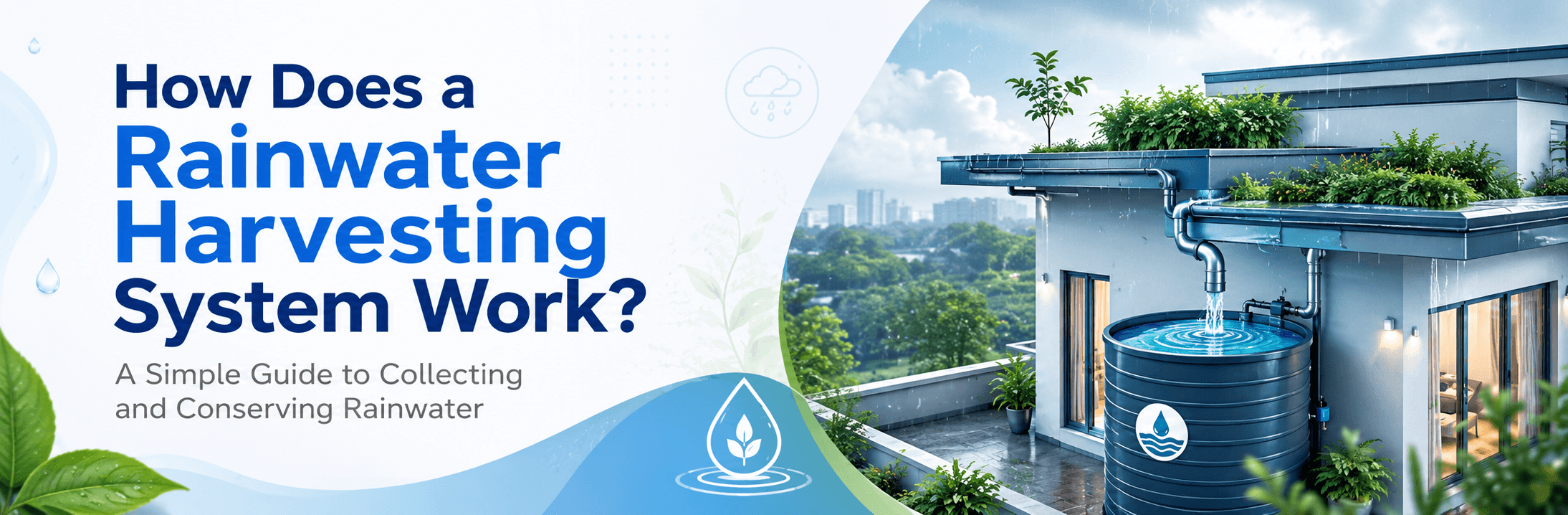
A basic rooftop system has four main parts: a catchment, a conveyance system, filtration, and storage or recharge. These are also identified as core elements in the Ministry of Housing and Urban Affairs’ guidance on rainwater harvesting.
The roof acts as the catchment surface. Gutters and downpipes carry water away from the roof. A first-flush arrangement diverts the initial rainfall, which may contain dust, leaves, bird droppings, and other contaminants. The remaining water passes through a filter before entering a tank or recharge structure.
An overflow outlet is also necessary. Once the system reaches capacity, excess water should be directed safely towards a drain, garden, pond, or another approved outlet.
The amount harvested depends mainly on local rainfall, catchment size, roof material, and system efficiency. A large roof will not deliver good results if pipes are undersized, filters are blocked, or storage is poorly planned.
Main Types of Rainwater Harvesting
Rooftop Rainwater Harvesting
This is one of the most common methods for homes, apartments, offices, schools, hospitals, and factories. Rain falling on a roof is collected through gutters and pipes, filtered, and either stored or directed into a recharge system.
Surface Runoff Harvesting
This method captures water flowing across land, roads, parks, open grounds, or agricultural fields. The runoff may be directed into ponds, tanks, percolation basins, check dams, or recharge structures.
It requires careful planning because runoff may carry soil, waste, oil, chemicals, and other pollutants.
Groundwater Recharge
Recharge systems allow filtered rainwater to enter the ground and replenish aquifers. Common structures include recharge pits, trenches, shafts, and wells. Their suitability depends on soil, geology, groundwater level, available space, and water quality.
A recharge pit is not a universal solution. Poorly designed systems can introduce contaminated water into the ground, so site-specific assessment is important.
Why India Needs Rainwater Harvesting

India’s water challenge is not only about how much rain falls. It is also about when it falls, how quickly it becomes runoff, and how effectively it is stored.
Rapid urbanisation has replaced many permeable surfaces with buildings, roads, and concrete. This reduces natural infiltration and sends rainwater rapidly into drains. UN-Water notes that extensive urban paving can channel runoff too quickly into storm drains and increase flooding risks when systems are overwhelmed.
Many urban and rural areas also depend heavily on groundwater. When extraction exceeds natural recharge, water tables can decline and wells may become less reliable. Capturing rain close to where it falls can reduce demand on supplied water and support local recharge, although results vary by site.
Rainfall is also becoming less predictable in many places. Longer dry periods and short episodes of intense rain make water management more difficult. UN-Water identifies rainwater capture as useful in areas with uneven rainfall because it can build resilience and retain water for drier periods.
Benefits of Rainwater Harvesting
The most direct benefit is reduced dependence on municipal supply, tanker water, borewells, or other external sources. Even when harvested water is used only for flushing, gardening, washing, or landscaping, it can reduce demand for treated freshwater.
Rainwater harvesting can also support groundwater recharge where local conditions allow. This is especially valuable when systems are planned across multiple buildings or neighbourhoods.
Another benefit is stormwater management. Capturing part of the rainfall at building or site level can slow runoff and reduce pressure on drains. It cannot prevent every flood, but it can contribute to a wider urban drainage strategy.
For businesses and institutions, rainwater harvesting can support water-efficiency goals, green building efforts, operational resilience, and environmental reporting.
Application | Potential benefit |
Homes and apartments | Lower use of supplied water for non-drinking purposes |
Schools and institutions | Water for gardens, cleaning, and sanitation |
Commercial buildings | Reduced freshwater demand and better runoff management |
Industries | Supplementary water for approved non-potable processes |
Farms and rural areas | Irrigation support, soil moisture, and recharge |
Is Harvested Rainwater Safe to Use?
Rainwater may appear clean, but it can pick up contaminants from the air, roof, gutters, pipes, and tank. Leaves, dust, animal waste, insects, microorganisms, metals, and chemicals may affect its quality.
The Centers for Disease Control and Prevention advises that water quality must match its intended use. Water used for drinking requires a much higher level of treatment and monitoring than water used for gardening.
For most buildings, non-potable uses are the simplest starting point. Tanks should be covered, inlets screened, stagnant water avoided, and systems protected from mosquitoes. Where water is intended for bathing, cooking, drinking, or food-related processes, suitable treatment, regular testing, and compliance with applicable standards are essential.
Water contaminated by sewage, industrial discharge, oil, or chemicals should never be directed into groundwater.
Common Mistakes and Maintenance Needs
A rainwater harvesting system is not a one-time installation that can be forgotten. Lack of maintenance is one of the main reasons systems stop working.
Roofs and gutters should be cleaned before the monsoon. Filters need periodic cleaning or replacement. First-flush devices should be checked, tanks inspected, and silt removed from recharge structures when required. Broken pipes, leaks, mosquito entry points, and unsafe overflows should be corrected promptly.
Another common mistake is copying a standard design without considering local conditions. Soil type, rainfall intensity, roof area, groundwater depth, building use, and water demand should guide the design.
Oversized claims should also be avoided. A small recharge pit cannot compensate for unlimited groundwater extraction, and a storage tank cannot provide year-round supply unless rainfall, storage, and demand are properly balanced.
Rainwater Harvesting for Businesses and Cities
For businesses, rainwater harvesting should be part of an integrated water-management plan. The first step is to understand the site’s water balance: how much water enters, where it is used, how much wastewater is generated, and how rainfall moves across the property.
The system can then be designed around realistic uses and site conditions. Metering harvested water helps businesses measure performance rather than reporting only that a structure exists.
At the city level, individual systems are useful but insufficient on their own. Rainwater harvesting works best alongside protected lakes and wetlands, functioning drains, permeable surfaces, urban green spaces, wastewater reuse, and responsible groundwater regulation.
The Ministry of Housing and Urban Affairs’ urban water-conservation guidelines include rainwater harvesting and groundwater recharge solutions for urban buildings. The broader lesson is that rainfall should be managed as a local resource, not treated only as water that must be removed from a site.
Conclusion
Rainwater harvesting is one of the most practical ways to connect water conservation with climate resilience. It captures rain close to where it falls, reduces avoidable runoff, supports non-potable water use, and can contribute to groundwater recharge.
Its success, however, depends on more than constructing a tank or pit. Systems must be designed for local rainfall, geology, water demand, and water quality. They also need regular maintenance and realistic performance monitoring.
For India, where intense monsoon rainfall can exist alongside seasonal water shortages, rainwater harvesting offers an important shift in thinking. Rain is not only a drainage problem. It is a resource that can be stored, slowed, reused, and returned to the ground.
When combined with water efficiency, wastewater reuse, ecosystem protection, and better urban planning, rainwater harvesting can become a meaningful part of a more water-secure and sustainable future.
FAQs
1. What is rainwater harvesting?
Rainwater harvesting is the process of collecting and storing rainwater for reuse or groundwater recharge.
2. How does rainwater harvesting work?
Rainwater is collected from rooftops or surfaces, filtered, and stored in tanks or directed into recharge structures.
3. What are the main types of rainwater harvesting?
The main types are rooftop rainwater harvesting, surface runoff harvesting, and groundwater recharge.
4. What are the benefits of rainwater harvesting?
It reduces freshwater demand, supports groundwater recharge, lowers runoff, and improves water security.
5. Why is rainwater harvesting important in India?
India receives seasonal rainfall, while many regions face groundwater depletion and water shortages during dry months.
6. Can harvested rainwater be used for drinking?
Yes, but only after proper filtration, treatment, testing, and compliance with drinking-water standards.
7. Where can harvested rainwater be used?
It can be used for gardening, flushing, cleaning, irrigation, landscaping, and suitable industrial processes.
8. What is rooftop rainwater harvesting?
It is a system that collects rain falling on rooftops and directs it into storage tanks or recharge pits.
9. Does rainwater harvesting help prevent flooding?
It can reduce and slow surface runoff, helping lower pressure on urban drainage systems.
10. Does a rainwater harvesting system require maintenance?
Yes. Gutters, filters, tanks, first-flush devices, and recharge structures must be cleaned and inspected regularly.

Other articles




We work with individuals, startups, and NGOs dedicated to forging a sustainable future. Tell us about your mission.

